Marine Helical Gear Applications — Why Marine Is Different
Three environmental factors distinguish marine спирална предавка applications from equivalent industrial land-based drives. First, saltwater atmosphere — even inside enclosed machinery spaces, the air is saturated with salt-laden moisture that corrodes carbon steel surfaces, attacks seal lips, and accelerates fretting corrosion at fitted interfaces within weeks without corrosion protection. Second, operational temperature range: vessels operating in Arctic routes or Norwegian fjord service experience ambient temperatures of −30°C to −40°C, at which standard alloy steel gear materials may lose fracture toughness — a requirement that mandates Charpy impact testing at −40°C as part of classification society material certification. Third, classification society mandatory design review and inspection witness: DNV GL, Lloyd’s Register, ABS, Bureau Veritas, and Korean Register require that critical marine спираловидни зъбни колела be designed and inspected to their published rules, with class society surveyors witnessing material tests and final inspection before installation.
Корейски Ever-Power консумативи спираловидни зъбни колела for all marine application categories in this article, with in-house capability for classification society documentation and third-party witness inspection at every production stage.
Ship Main Propulsion Gearboxes — The Most Demanding Marine Helical Gear Application
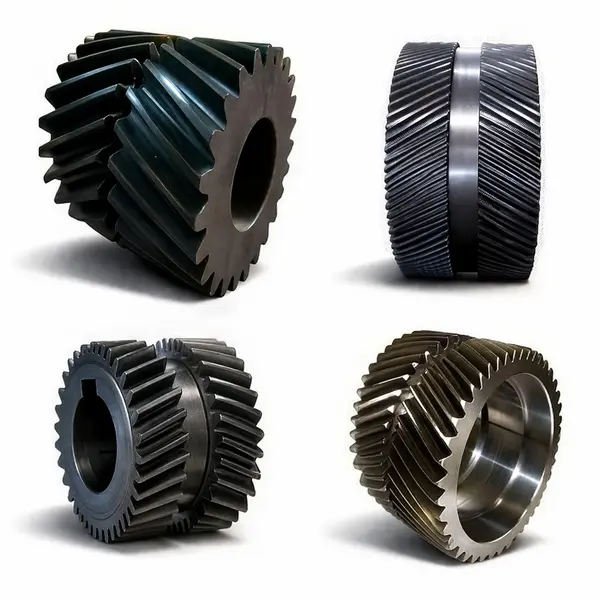
Double helical herringbone propulsion gear — maximum helix angle (30–42°) for lowest underwater radiated noise, with zero net axial force at the shaft. The standard configuration for commercial ship and naval vessel main propulsion reduction gearboxes worldwide
Why Double Helical Gears Are Universal in Marine Main Propulsion
Ship main propulsion gearboxes reduce turbine or diesel engine speed (3000–18,000 RPM) to propeller shaft speed (80–200 RPM) across a total ratio of 15:1 to 100:1 in one or two stages. The mandatory use of double helical (herringbone) спираловидни зъбни колела in main propulsion gearboxes has two independent engineering reasons:
- Acoustic signature (naval and passenger vessels): Propeller shaft bearings and the stern tube bearing are radial load bearings with essentially zero axial load capacity. Any axial thrust from a single спирална предавка driving the propeller shaft must be absorbed at the stern tube bearing — which is not designed for this. Double helical gears eliminate the axial force at the gear body. Additionally, at the helix angles achievable without axial thrust penalty in a double helical configuration (β = 30–42°), the total contact ratio ε_γ = 4.0–5.5, producing the lowest mesh-frequency noise of any cylindrical gear — critical for naval vessels where acoustic signature directly affects detectability and for passenger cruise ships where cabin noise is a commercial parameter.
- Classification society rules: DNV GL Rules for Classification, Ships Part 4 Chapter 2 Section 2.3 (Gears and Gear Drives) mandates двойна спирална предавка configuration for main propulsion reduction gearboxes in most vessel categories. This is not a designer’s preference but a binding rule, compliance with which is verified by the classification society surveyors.
Marine Propulsion Helical Gear Material and Certification
| Vessel Type | Материал на зъбното колело | Термична обработка | Charpy Requirement | Classification |
|---|---|---|---|---|
| Commercial vessels (tropical/temperate routes) | 20CrMnTi or 17CrNiMo6 | Carburized HRC 58–62, ground DIN 5–7 | 27 J at 0°C minimum | DNV, LR, ABS, KR |
| Vessels in ice class or Arctic routes | 17CrNiMo6 (mandatory) | Carburized HRC 58–62, ground DIN 5–6 | 27 J at −40°C minimum per DNV ICE class rules | DNV, LR ice class notation |
| Naval surface vessels | 17CrNiMo6 shock-proof grade | Carburized HRC 55–60, with controlled case-core transition | 35 J at −40°C; UNDEX shock test simulation | Naval bureau; MILSPEC |
| Submarine propulsion | 17CrNiMo6 or proprietary naval grade | Carburized, precision ground DIN 4–5 | As naval; plus acoustic qualification test | Naval bureau; classified |
Azimuth Thruster and Tunnel Thruster Gearboxes
Azimuth thrusters — retractable or fixed pod-mounted propellers that can rotate 360° for vessel manoeuvring — contain a bevel gear stage (for the 90° direction change from vertical drive shaft to horizontal propeller shaft) followed by a спирална предавка reduction stage. The спирална предавка stage reduces the hydraulic motor speed (typically 500–2000 RPM) to the propeller speed (150–500 RPM) and must be compact and sealed for long-term underwater operation. Tunnel thrusters (bow and stern) use a similar architecture but in a fixed orientation inside a transverse tunnel through the hull. Both applications require:
- Full external corrosion protection — sacrificial anode protection or impressed current cathodic protection for submerged gearbox housings; nickel-chrome plated or stainless external hardware
- Helical gear sealed housing — no periodic oil change possible on a submerged thruster; oil specification and fill volume must sustain the gear service life (typically 5 years between dry-dock inspections)
- Material compatibility — all elastomer seals, O-rings, and bearing cage materials must be compatible with the synthetic marine gear oil and with seawater if the seal is breached
Offshore Platform Winch and Crane Drives

Твърд зъбен ръб, цементиран спирална предавка for offshore winch and crane duty — 17CrNiMo6 carburized at HRC 58–62, Charpy 27 J at −40°C certified, DIN Class 5–6 ground, with DNV or ABS class society material certification
Offshore drilling platforms and floating production storage and offloading (FPSO) vessels carry large cranes (100–5000 tonne lifting capacity) and anchor chain winches that use спирална предавка drives in the hoisting and slewing mechanisms. The offshore environment adds requirements beyond standard industrial crane gears:
The drilling area of an offshore platform is classified as a hazardous area (ATEX Zone 2) where explosive gas atmospheres may occur. Gearboxes operating in these zones must have explosion-proof rated motors and any gearbox instrumentation (temperature sensors, oil flow monitors) must be Ex-rated. The спираловидни зъбни колела themselves are passive mechanical components and are not ATEX-rated individually, but the complete drive assembly must be assessed.
External surfaces of gearbox housings exposed to the offshore marine atmosphere require high-build epoxy primer plus topcoat to NORSOK M-501 or equivalent standard. Fasteners must be A4-grade stainless steel. Gear tooth flanks inside the housing are protected by continuous oil bath lubrication — maintaining the oil level and seal integrity is the single most important corrosion maintenance task.
Offshore operators require FMEA (Failure Mode and Effects Analysis) for safety-critical drives including anchor winches and personnel-handling cranes. The спирална предавка failure modes (pitting, tooth fracture) must be identified, their probability estimated, and detection methods specified — typically oil metal particle count monitoring and vibration signature trending.
Marine Auxiliary Drive Helical Gears — Pumps, Fans and Generators
Beyond propulsion and crane drives, vessels contain dozens of auxiliary systems with спирална предавка drives: ballast water pump gearboxes, fire pump drives, HVAC blower gearboxes, diesel generator speed increasers, and emergency generator drives. These auxiliary спираловидни зъбни колела carry lower loads than propulsion gears but operate in the same corrosive environment and must meet the same classification society material documentation requirements for safety-critical systems (fire pumps, emergency generators).
For non-safety-critical marine auxiliary спираловидни зъбни колела (HVAC, ballast pumps), the specification is typically: 42CrMo QT HB 280–320, DIN Class 7–8 precision hobbing, standard industrial corrosion protection. For safety-critical auxiliary drives (fire pump, emergency generator): 17CrNiMo6 carburized and ground, Charpy at minimum service temperature, class society material certificate.
Classification Society Requirements for Marine Helical Gears — What Approval Means
Classification society approval for a marine спирална предавка is not simply a paper certification — it requires active witness inspection at specific production stages. For DNV GL, Lloyd’s Register, ABS, Bureau Veritas, or Korean Register class approval of main propulsion and safety-critical gear drives, the requirements typically include:
| Inspection Stage | Class Society Involvement | Documentation Produced |
|---|---|---|
| Material approval | Surveyor witnesses mechanical tests (tensile, yield, elongation, Charpy at −40°C) at certified testing laboratory | Class-stamped material certificate with heat number |
| Ultrasonic inspection | Surveyor witnesses 100% UT of forged blanks per EN 10228-3 or ASTM A388 | UT report signed by Level 3 UT inspector |
| Термична обработка | Furnace records and test coupons from same batch verified; surveyor may witness hardness survey and case depth measurement | Heat treatment record, hardness survey, metallographic section report |
| Final gear inspection | Surveyor witnesses gear analyser measurement (profile/lead/pitch per DIN 3962), CMM dimensional report, MPI | Gear analyser report, CMM report, MPI report — all class-stamped |
| Документация | Full traceability from raw material heat number to finished gear inspection reports in approved format | Class Society Certificate with gear ID and vessel IMO number reference |
Korea Ever-Power — Marine Helical Gear Supply with Classification Society Support

Korea Ever-Power quality inspection accommodates DNV, Lloyd’s Register, ABS, Bureau Veritas, and Korean Register (KR) witness inspection at any production stage — material receipt, forging, heat treatment, and final gear inspection
Korea Ever-Power manufactures marine-grade спираловидни зъбни колела for main propulsion (double helical, DIN Class 5–7), thruster drives, and offshore crane gears in 17CrNiMo6 with Charpy certification at −40°C. As a direct производител на спирални зъбни колела in Korea with full in-house forging, heat treatment, grinding, and inspection, Korea Ever-Power provides complete documentation traceability without gaps between subcontractors — a specific advantage for class society audits that require continuous material traceability from heat number to shipped component.
Често задавани въпроси
DNV GL ICE class notation and Lloyd’s Register icebreaker class rules require Charpy V-notch impact energy of minimum 27 J at −40°C for main propulsion and safety-critical спираловидни зъбни колела on vessels in polar service. This requirement mandates 17CrNiMo6 as the gear material — 20CrMnTi does not reliably meet 27 J at −40°C due to its lower nickel content. Test specimens are cut from the forged blank (not from bar stock) and tested at a certified laboratory with class society surveyor witness. The test results appear on the class-stamped material certificate that accompanies the gear through its service life.
Naval vessels — surface ships and submarines — must minimise underwater radiated noise (URN) to reduce their acoustic detectability. The main propulsion reduction gearbox is one of the dominant contributors to URN at low speeds. Double helical спираловидни зъбни колела at helix angles of 30–42° produce total contact ratios of 4.0–5.5, giving the lowest mesh-frequency noise of any cylindrical gear configuration. The zero axial thrust of the double helical configuration additionally simplifies the propeller shaft bearing arrangement — removing gear thrust from the stern tube bearing’s load budget. Naval specifications typically require 100% gear analyser measurement on every tooth, DIN Class 4–5, Ra ≤ 0.3 µm, plus acoustic qualification by vibration signature measurement under full load in a test stand before installation.
An underwater explosion near a naval vessel generates a severe shock pulse transmitted through the hull structure to the gearbox and its contents. UNDEX shock levels are specified in terms of shock grade (Grade A, B, C under MIL-S-901D) and the gearbox must be designed to survive without permanent deformation or gear tooth fracture. For спираловидни зъбни колела in naval shock-qualified drives, this translates to specifying the tooth root bending stress under the shock peak torque (typically 3–5× rated torque applied instantaneously) and ensuring the material toughness at the service temperature provides adequate crack arrest capability. The controlled case-core transition of marine-grade carburized gears — shallower case depth to keep the brittle case from extending to the root fillet — is specifically designed to pass UNDEX qualification.
Yes. For replacement gear orders, Korea Ever-Power measures the worn gear by gear analyser, OES spectrometer, and CMM — producing a complete specification from the worn component. The replacement is manufactured to the measured specification in the correct material grade with appropriate classification society documentation. If the original classification certificate is available, the replacement is produced to the same material and inspection standard. If not, Korea Ever-Power can produce the gear with KR (Korean Register) class certification as a default option. Replacement gear lead time for medium-size marine спираловидни зъбни колела (M8–M20, OD 100–400 mm): typically 8–14 weeks. For large main propulsion pinions (M20–M40, double helical): 16–24 weeks.
Marine Gear Enquiry — Classification Society Documentation Available
Submit your gear specification with required classification society, vessel IMO number, and material standard. Korea Ever-Power confirms production schedule and documentation package within 24 working hours.
DNV · LR · ABS · BV · KR class documentation · 17CrNiMo6 · Charpy −40°C · Double helical · DIN Class 4–7
Редактор: Cxm