Types of Helical Gears: Single, Double, Crossed, Rack
Technical analysis of parallel and non-parallel shaft transmission configurations. Evaluate kinematic differences in overlap ratios, Hertzian contact stress, and axial load distribution to specify the proper mechanical drive.
Mechanical Principles of Inclined Teeth
Straight-cut teeth transfer rotational force simultaneously across the entire face width, leading to severe shock impacts and acoustic resonance at elevated peripheral speeds. Modifying the gear blank by cutting teeth at a calculated angle to the rotational axis produces a helical gear. This geometric alteration forces gear engagement to initiate at the leading edge and progress diagonally across the flank.
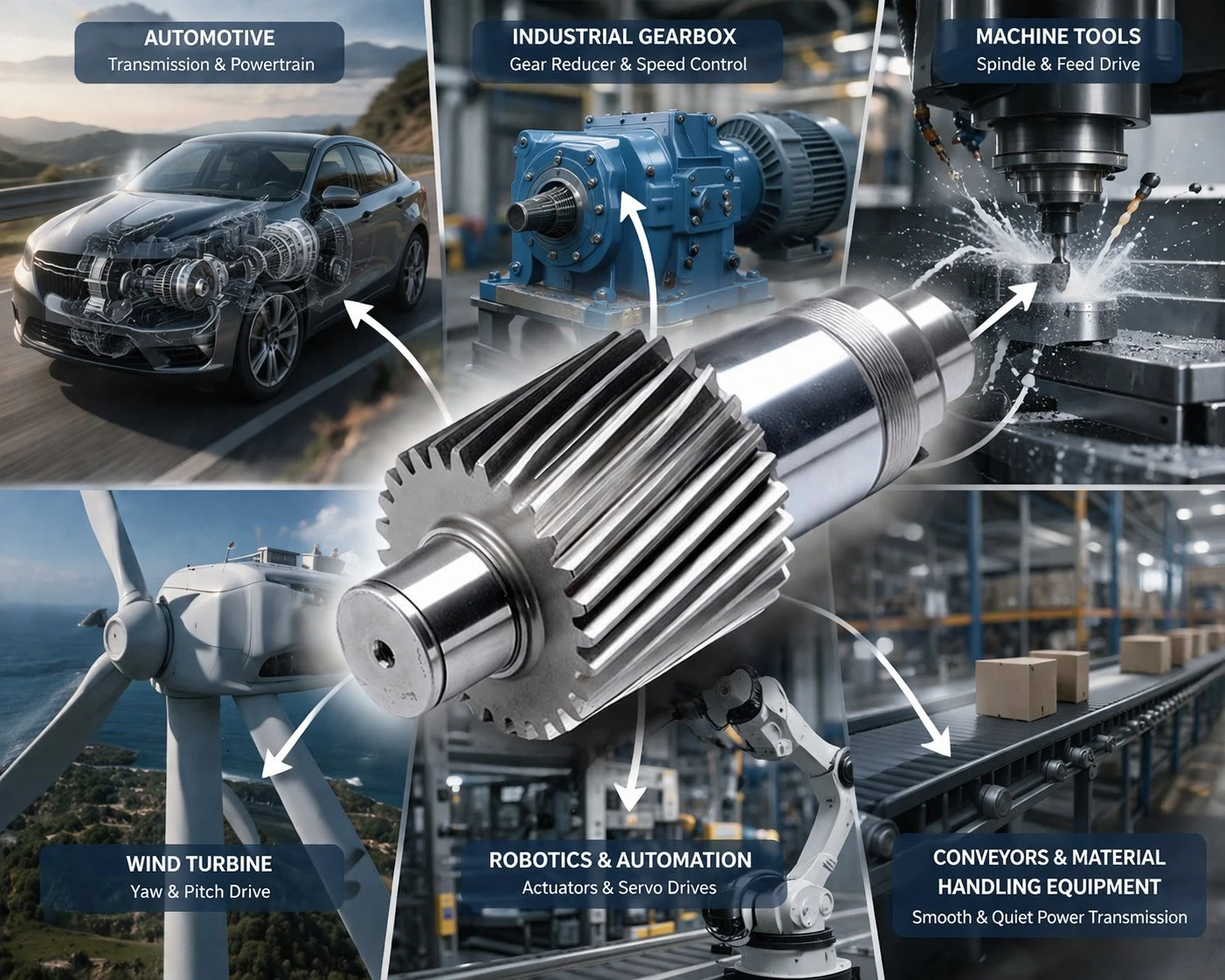
This overlapping mesh sequence yields a significantly higher total contact ratio. Multiple tooth profiles share the dynamic load, practically eliminating transmission error. Depending on spatial constraints and shaft orientation limits, mechanical engineers categorize these components into specific types of helical gears. Identifying the correct configuration among हेलिकल कट गियर guarantees the power transmission unit meets its continuous operating life targets without bearing fatigue.

Engineering Specification Comparison
Prior to detailing individual geometries, the following matrix benchmarks the primary operational mechanics and lateral force variations differentiating the four categories.

| Configuration Type | Required Axis Alignment | Axial Force Management | Mesh Kinematics |
|---|---|---|---|
| एकल पेचदार | समानांतर | High thrust bearings mandatory | Diagonal line contact |
| डबल हेलिकल | समानांतर | Internal cancellation (Zero net load) | Symmetrical line contact |
| Crossed (Skew) | Non-intersecting (90 degree typical) | Light thrust bearings required | Point contact with high sliding friction |
| Helical Rack | Rotary to linear translation | Thrust absorbed by pinion housing | Multi-tooth continuous mesh |
Single Helical Gear: Standard Parallel Drive

The single helical variant serves as the baseline for high-speed automotive gearboxes and industrial reducers. It comprises a continuous cylindrical blank with teeth machined at a constant angle. To transfer torque between parallel shafts, two meshing gears must share identical normal module metrics and helix angles, but they are required to have opposite hand twists. A right-hand pinion mates only with a left-hand gear.
Axial Thrust Vectoring
Applying tangential driving force across an angled surface resolves into an unavoidable lateral force vector. This axial thrust attempts to displace the gear along the shaft. Powertrains utilizing single helical units dictate the installation of angular contact bearings to absorb this lateral load. Standard helix angles range strictly between 15 and 30 degrees to balance acoustic noise reduction against bearing fatigue.
Double Helical and Herringbone Geometries
When powertrain torque scales up in heavy applications like ball mills or ship main propulsion systems, the lateral thrust from single configurations rapidly exceeds the housing capacity of standard bearings. Designers specify a डबल हेलिकल गियर to neutralize this issue. By cutting opposed right-hand and left-hand tooth tracks onto the same face width, the opposing thrust forces cancel internally. This permits steeper helix angles for massive load capacity.
Tool Clearance Groove
Standard double designs feature a circumferential groove separating the two opposing helixes. This machined gap acts as a runout zone for continuous hobbing cutters, allowing the tool to exit the metal without colliding with the adjacent angled teeth.
Continuous Apex Structure
A true herringbone gear eliminates the central groove. The teeth intersect exactly at the apex to form a continuous V geometry. Generating a herringbone profile requires specialized reciprocating Sykes gear shapers, resulting in higher manufacturing costs.
Crossed Helical Gears for Non-Parallel Axes

Referred to technically as skew gears, crossed assemblies transfer rotation between axes that are non-parallel and non-intersecting. A 90 degree shaft arrangement is the standard industrial application. Depending on the exact shaft angle calculated, crossed pairs can physically utilize two gears of the identical hand twist.
Hertzian Point Contact Limits
The structural flaw here is load capacity. The meshing kinematics dictate theoretical point contact rather than robust line contact. Under load, this interface compresses into a tiny ellipse experiencing severe sliding friction. High sliding velocity strips lubrication films instantly. For transmitting heavy torque at 90 degrees, industrial designers mandate वर्म गियर drives instead of crossed helicals.
Helical Rack and Pinion: Linear Translation
Unrolling a gear pitch cylinder to an infinite radius creates a flat rack. The helical rack and pinion drive converts rotational output from a servo motor directly into precise linear carriage positioning. By utilizing angled teeth on the flat bar, the pinion meshes continuously with multiple rack teeth.
This overlapping engagement neutralizes the cogging effect typical in straight spur racks. The continuous contact dampens micro-vibrations and practically eliminates mechanical backlash during rapid carriage reversal. These dynamic kinematic properties make helical racks standard equipment on heavy-duty CNC routing tables and automated laser cutting gantries.
Korea Ever-Power: Manufacturing Tolerances

Formulating theoretical kinematics is merely the initial design phase; fatigue life depends entirely on metallurgical hardening control and profile grinding execution. As a specialized South Korean हेलिकल गियर निर्माता, कोरिया एवर-पावर वर्म गियर कंपनी लिमिटेड machines components to rigorous DIN ISO 1328 accuracy grades.
Operating an ISO 9001 certified grinding center equipped with advanced German HÖFLER machinery, we execute strict micro-geometry modifications like tip relief and lead crowning. We supply B2B industrial partners across Korea, Japan, and Southeast Asia, producing everything from compact carburized pinions to custom double helical structures up to 2500mm outer diameter.
इंजीनियरिंग से संबंधित अक्सर पूछे जाने वाले प्रश्न
Does modifying the helix angle alter the different types of helical gears?
The helix angle governs both the transverse overlap ratio and axial thrust. Steeper angles dampen vibration but proportionately increase lateral push force. Single gears usually limit the angle to 30 degrees to prevent bearing overload. Double configurations can exploit angles exceeding 40 degrees since the opposed thrust forces cancel out internally.
Can standard gear oil lubricate crossed helical setups?
Standard mineral oils frequently fail under point contact sliding friction. Crossed axes typically require extreme pressure additives or fully synthetic base stocks to maintain the elastohydrodynamic film boundary. Pairing a hardened steel gear with a phosphor bronze mating gear also mitigates friction-induced galling.
What purpose does the center groove serve on double units?
The relief groove acts as tool clearance. When a continuous hobbing cutter shapes the right-hand teeth, it requires an empty channel to exit the cut without destroying the adjacent left-hand teeth. Eliminating the groove necessitates slower reciprocating shaper machinery.
Why do helical racks minimize positioning errors?
Straight racks transfer full load abruptly across one tooth interface. Helical tracks maintain partial engagement across two or more teeth simultaneously. This overlap averages out micro pitch errors along the rack length, delivering sub-millimeter repeatable positioning for automation carriages.
Does a single helical rack create lateral thrust on the pinion?
Yes. While the rack itself is bolted stationary to the track, the angled meshing transfers lateral thrust back into the driving pinion. The servo gearbox supporting the pinion shaft must contain angular contact bearings rated to absorb this reaction force.
Specify Precision Industrial Drive Components
Control transmission error and increase mechanical load capacities. कोरिया एवर-पावर delivers DIN-certified gear manufacturing for heavy industry. Submit engineering drawings for prompt technical evaluation.
संपादक: सीएक्सएम