Helical Gear vs Bevel Gear: Complete Engineering Guide
Analyze the kinematic characteristics of parallel and intersecting shaft drivetrains. Evaluate pitch geometry, mounting distance tolerances, and separating forces to specify the optimal power transmission architecture for heavy industrial applications.
Drive Architecture Overview
Specifying the correct mechanical transmission topology requires mapping the spatial constraints between the prime mover and the driven equipment. The foundational debate of a helical gear vs bevel gear is dictated by shaft kinematics. Engineers do not substitute these systems arbitrarily; the physical equipment envelope determines the necessary gear geometry to transfer torque without structural interference.
Helical transmission components function exclusively across parallel shafts. They rely on cylindrical pitch surfaces to transfer high radial loads. Conversely, bevel gearboxes are engineered for intersecting axes—typically meeting at an orthogonal 90-degree angle. These intersecting setups utilize conical pitch surfaces to physically redirect mechanical power. Understanding how these distinct geometries handle tooth engagement, thermal expansion, and housing deflection prevents premature fatigue failures in heavy industrial machinery.
Engineering Specification Matrix

The operational ceilings of parallel and intersecting drives diverge rapidly under maximum torque. The table below benchmarks standardized parallel helical elements against intersecting spiral bevel configurations. These metrics assume identical metallurgy (e.g., carburized 20CrMnTi steel) and DIN Class 6 precision grinding profiles.
| Kinematic Parameter | Helical Mechanism (Parallel) | Spiral Bevel Mechanism (Intersecting) |
|---|---|---|
| Pitch Surface Shape | True Cylinder (Involute Helicoid) | Truncated Cone (Pitch Cone) |
| Maximum Velocity Limit | Exceeds 150 m/s (Ground Profile) | Mechanically capped at 60 – 80 m/s |
| Generated Vector Forces | Radial Load + Axial Thrust | Radial + Axial Thrust + Separating Force |
| Axial Assembly Tolerance | Permits minor longitudinal shaft expansion | Zero tolerance; strict apex intersection required |
| Primary Manufacturing Method | Standard CNC Hobbing & Grinding | 5-Axis Face Milling / Face Hobbing |
Parallel Axes: Helical Mesh Dynamics and Contact Ratio
Šroubovitá ozubená kola are cut along a cylindrical base blank. The defining geometric feature is the helix angle. Because the teeth are angled obliquely to the axis of rotation, the involute profiles engage with a sliding overlap. Mesh contact initiates at one specific point on the leading edge and propagates diagonally across the tooth face as the shaft rotates.
This gradual engagement sequence generates a massive transverse and axial contact ratio. Multiple tooth flanks transmit the applied motor torque simultaneously. This overlap neutralizes localized bending stress and limits Transmission Error (TE). Consequently, parallel systems easily maintain an intact Elastohydrodynamic Lubrication (EHL) oil barrier, ensuring low acoustic resonance even under intense centrifugal speeds. Because the geometry remains cylindrical, thermal expansion of the shaft along its axis does not misalign the involute mesh.

Intersecting Axes: Conical Apices and Separation Forces

Evaluating the precise difference between helical and bevel gears mandates analyzing conical pitch geometry. Bevel components redirect torque across intersecting shafts utilizing truncated cone envelopes. For the mechanical power to transfer without inducing abrasive sliding friction, the theoretical tips of both cones (the apices) must intersect exactly at a specific spatial coordinate within the gearbox.
Industrial drive designers utilize spiral bevel variants to mimic the overlapping engagement of a helical mechanism. However, conical intersection is structurally volatile. The pressure angles generate aggressive separating forces, physically pushing the meshing gears apart under load. If the cast iron casing deflects by just 0.05mm, the Mounting Distance (MD) is compromised. The contact pattern abruptly shifts to the fragile toe or heel of the tooth, resulting in edge-loading, localized pitting, and rapid fracture.
Selecting Topologies for Heavy-Duty Applications

Deploying Parallel Architectures

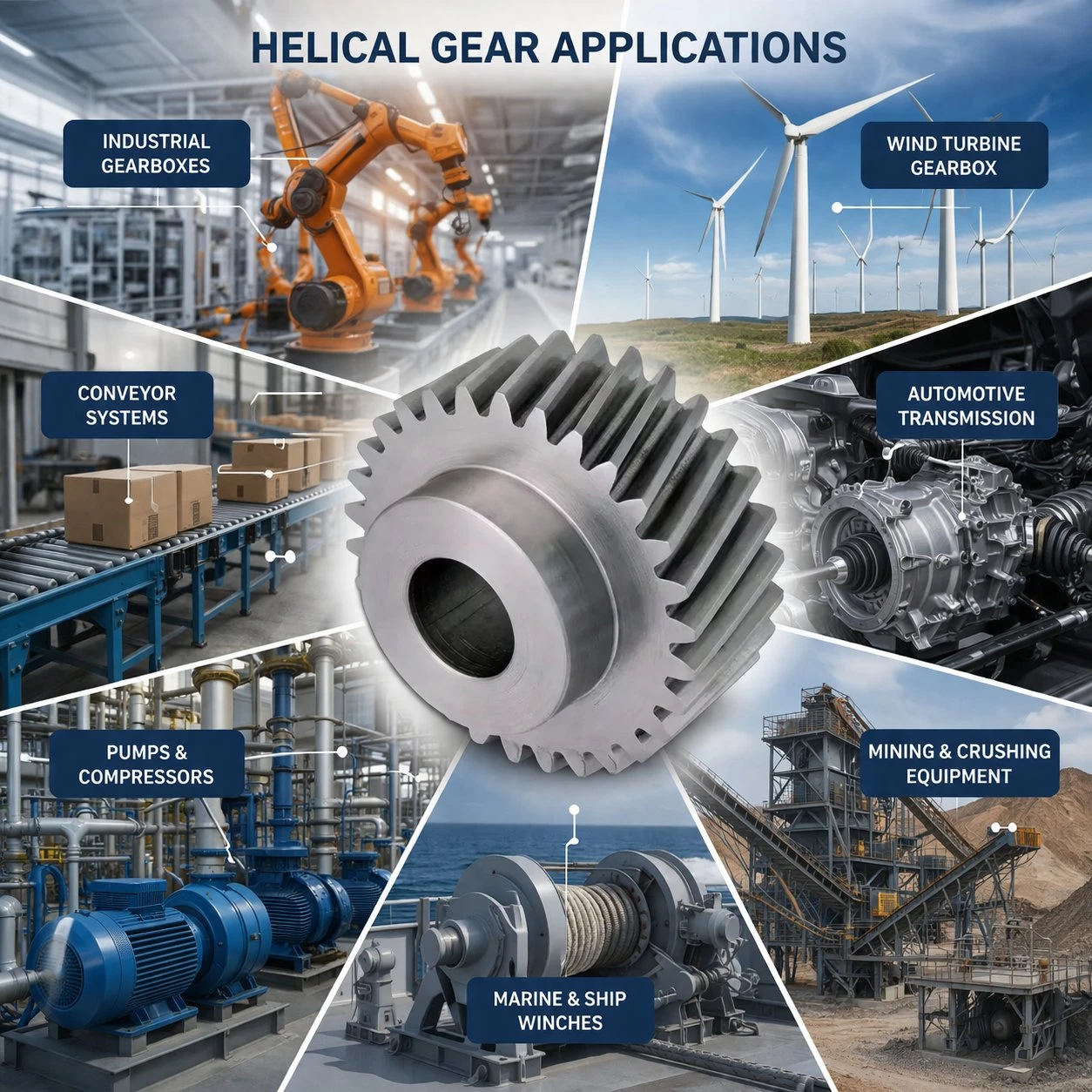
When mechanical footprints allow the motor input and machine output to align in parallel, helical systems offer the highest economic return and structural durability. They are the global standard for automotive manual transaxles, EV single-speed reducers, and high-velocity rotary compressors.
Technical Notice: When axial thrust generated by the helix angle exceeds standard tapered bearing ratings in heavy steel mills, design teams deploy a dvojité spirálové ozubené kolo. The opposing tooth angles act symmetrically to cancel axial thrust completely.
Deploying Intersecting Architectures
Conical configurations are specified strictly out of spatial necessity. When kinetic power must traverse a 90-degree corner—such as routing a vehicle’s longitudinal driveshaft output to the transverse rear axles—intersecting geometries are mandatory.
Technical Notice: If an application requires a 90-degree turn coupled with a massive single-stage reduction (e.g., 50:1) and self-locking capabilities to prevent backdriving, substitute the assembly with a heavy-duty šnekový převod mechanismus.
Korea Ever-Power: Precision Manufacturing Capability

Mitigating gear whine and preventing localized fatigue failure requires precise metallurgical analysis and sub-micron hobbing accuracy. Functioning as a dedicated výrobce šikmých ozubených kol se sídlem v Jižní Koreji, Korea Ever-Power Worm Gear Co., Ltd. engineers heavy-duty transmission components for industrial procurement engineers across Japan and Southeast Asia.
- Grinding Technology: Deploying premium German HÖFLER profile grinding machinery.
- Machining Envelope: Processing parallel components up to 2500mm in Outer Diameter (OD).
- Tolerance Control: Executing DIN Class 3 to 9 accuracy grades to stabilize contact ratios.
- Quality Auditing: ISO 9001 certified facility implementing precise tip relief and lead crowning modifications to neutralize edge loading.
Často kladené technické otázky
Are parallel drives and intersecting drives mechanically interchangeable?
No. Direct substitution is physically impossible. Swapping transmission architectures requires engineering a new cast housing to accommodate the 90-degree shaft relocation, recalculating mounting distance (MD), and restructuring the entire bearing topology to handle new axial and separating force vectors.
Can crossed helical mechanisms execute right-angle industrial torque transmission?
While crossed helical gears connect non-parallel, non-intersecting axes at a 90-degree angle, their geometry resolves into theoretical point contact rather than line contact. This physical constraint generates immense specific sliding rates, limiting crossed helical configurations to low-torque instrumentation equipment. Applying heavy industrial torque causes immediate scuffing failure.
How does shaft thermal expansion affect these two configurations differently?
Thermal expansion presents severe design challenges for intersecting geometries. As the shaft lengthens, it pushes the pitch cone apex out of alignment, degrading the contact patch and inducing gear whine. Parallel cylinders remain largely unaffected; minor axial displacement along the involute face does not distort the established mesh ratio.
What drives the manufacturing cost discrepancy between the two formats?
Cylindrical blanks utilize highly standardized, continuous CNC hobbing processes, yielding excellent economies of scale. Conversely, generating 3D epicycloidal curves across a conical face demands proprietary 5-axis face milling or face hobbing centers (e.g., Gleason machinery), followed by matched-set lapping operations. This radically increases machining hours and specialized tooling costs.
Do both architectures demand tapered roller bearings?
Yes. The helix angle generates linear axial thrust parallel to the shaft. Intersecting conical gears generate both axial thrust and radial separating forces. Both topologies require heavy-duty tapered roller bearings or angular contact bearings to secure the shafts radially and axially against dynamic shock loads.
Specify Industrial-Grade Drivetrains
Prevent localized stress failures and acoustic compliance issues in your parallel machinery. Transmit your CAD blueprints to Korea Ever-Power engineers for a comprehensive metallurgical and machining evaluation.
Střihač: Cxm