Blødtandet flanketandhjul — DIN klasse 6 til valseværkshjælpedrev

Korea Ever-Power supplies this soft tooth flank helical gear in quenched-and-tempered 45# carbon steel — Mn=3, Z=128, helix angle β=11.5°, pressure angle 20°, left-handed, DIN 3962 class 6. Manufacturing sequence: forging → lathing → hobbing → external grinding → keyway milling → tooth grinding. Surface hardness HB 220–280 after QT treatment. Pitch diameter 384mm. Large-size metallurgy machinery auxiliary drive applications. Manufacturing capability covers external gears up to 2500mm O.D. and module 45mm.
Soft Tooth Flank Helical Gear for Metallurgy Machinery — Overview
EN soft tooth flank helical gear is a gear whose tooth flanks are left in the normalized or quenched-and-tempered condition after hobbing and grinding, rather than being case-hardened to a high surface hardness. In this product, the material is 45# carbon steel quenched and tempered to HB 220–280 — a moderate hardness range that gives a workable balance of bending strength, surface wear resistance, and machinability. Unlike carburized spiralformede tandhjul that achieve HRC 58–62 on the tooth surface, soft tooth flank gears are deliberately kept at a hardness where the tooth flanks can slightly conform under load during an initial run-in period, self-correcting minor tooth lead and profile errors that arise from assembly misalignment or gearbox housing tolerances. This run-in characteristic makes soft tooth flank gears particularly suited to large-scale metallurgy machinery auxiliary drives where perfect shaft alignment cannot always be guaranteed over the full gear body width.
The reference specification for this product is Mn=3, Z=128, helix angle β=11.5°, pressure angle 20°, left-handed, giving a pitch diameter of 384mm. The large tooth count and moderate module produce a gear with a high contact ratio and inherently smooth torque transmission, suitable for the long continuous-duty cycles characteristic of metallurgical rolling mill auxiliary drives, ore conveyor gearboxes, and slab transport line drives. Korea Ever-Power Worm Gear Co.,Ltd manufactures soft tooth flank helical gears from forged 45# blanks, finishing to DIN 3962 class 6 accuracy with tooth grinding. Find the complete range of industrial spiralformede tandhjul including both soft and hard tooth flank variants across our produkter med spiralformede gear katalog.
Tekniske specifikationer
Gearets grundlæggende data — Referencekonfiguration
| Parameter | Værdi |
|---|---|
| Gear tandform | Involveret |
| Gearmateriale | 45# Carbon Steel (Quenched and Tempered, HB 220–280) |
| Gearproces | Forging → Lathing → Hobbing → External Grinding → Keyway Milling → Tooth Grinding |
| Trykvinkel | 20° |
| Kvalitetsniveau | DIN 3962 Klasse 6 |
| Geartype | Mn=3, Z=128, β=11.5°, α=20°, Left-Handed |
| Calculated Pitch Diameter | 384 mm (Mn × Z) |
Produktionskapaciteter — Indvendige tandhjul og indvendige noter
| FRÆSNING | FORMNING | TANDSLIBNING | |
|---|---|---|---|
| Maksimal OD | 2500 mm | 2500 mm | 2500 mm |
| Minimum-ID | 650 mm | 50 mm | 100 mm |
| Maksimal ansigtsbredde | 500 mm | 500 mm | 500 mm |
| Maksimalt modul | 26 mm | 26 mm | 45 mm |
| AGMA / DIN-niveau | DIN Klasse 8 | DIN Klasse 8 | DIN Klasse 4 |
| Tandoverfladebehandling | Ra 3,2 | Ra 3,2 | Ra 0,6 |
| Maksimal helixvinkel | ±22,5° | ±22,5° | ±45° |
Produktionskapaciteter — Udvendige tandhjul og udvendige noter
| FRÆSNING | FRÆSNING | TANDSLIBNING | |
|---|---|---|---|
| Maksimal OD | 1250 mm | 2500 mm | 2500 mm |
| Minimum OD | 20 mm | 200 mm | 20 mm |
| Maksimal ansigtsbredde | 500 mm | 500 mm | 1480 mm |
| Maksimalt modul | 26 mm | 26 mm | 45 mm |
| AGMA / DIN-niveau | DIN Klasse 8 | DIN Klasse 8 | DIN Klasse 4 |
| Tandoverfladebehandling | Ra 3,2 | Ra 3,2 | Ra 0,6 |
| Maksimal helixvinkel | ±45° | ±45° | ±45° |
Soft Tooth Flank vs Hard Tooth Flank — Which Is Right for Your Drive?

The choice between a soft tooth flank helical gear and a hard tooth flank (carburized or induction-hardened) gear is one of the most consequential decisions in metallurgical drive design. Each approach has a distinct performance profile, and neither is universally superior. The following comparison addresses the parameters that matter most in metallurgy machinery gearbox specifications.
| Parameter | Soft Tooth Flank (45# QT, HB 220–280) | Hard Tooth Flank (Carburized, HRC 58–62) |
|---|---|---|
| Overfladehårdhed | HB 220–280 (uniform through cross-section) | HRC 58–62 surface; tough core beneath |
| Contact fatigue strength | Moderate — limits allowable contact stress | High — carburized case raises pitting resistance significantly |
| Run-in behavior | Favorable — tooth flanks conform slightly to correct minor misalignment | Minimal run-in — hard surface requires precise alignment from installation |
| Sensitivity to misalignment | Low — soft flanks tolerate small shaft alignment errors | High — misalignment creates edge loading on brittle hard case |
| Produktionsomkostninger | Lower — no carburizing furnace cycle required | Higher — carburizing adds processing time and cost |
| Suitable applications | Metallurgy auxiliary drives, conveyor gearboxes, moderate continuous duty | Mining, turbines, rolling mill main drives, high-speed high-shock applications |
45# Steel Quench-and-Temper Process for Metallurgy Gears

45# carbon steel is the most widely used material for soft tooth flank helical gears in metallurgy applications. It contains 0.42–0.50% carbon, 0.50–0.80% manganese, and limited alloying additions — a composition that responds predictably to quench-and-temper heat treatment and machines cleanly in the HB 220–280 tempered range. The complete processing sequence for this gear reflects established best practice for large industrial gears:

- Forging: The blank is press-forged from normalized 45# billet, aligning the grain flow with the gear's principal stress directions. Forging improves fatigue resistance over cast stock for large-diameter gear blanks and eliminates internal porosity from the solidification process.
- Quench and temper: The rough-turned blank is austenitized at approximately 840°C, water- or oil-quenched to form martensite, then tempered at 550–650°C to relax internal stresses and achieve the target hardness of HB 220–280. This step is performed before gear cutting, so the gear tooth form is hobbed and ground in the final heat-treated condition.
- Hobbing: Tooth form is generated by hobbing using a precision worm-type cutter. At HB 220–280, 45# steel machines with good surface quality in this operation and the hob tool life is acceptable — much better than attempting to hob a carburized gear, which requires the gear to be soft-cut before heat treatment and ground after.
- External grinding and keyway milling: Reference surfaces (bore, hub face, keyway) are ground and milled to final dimensions after the gear tooth form is cut, ensuring datum consistency.
- Tooth grinding: Final tooth grinding to DIN 3962 class 6 corrects any residual profile and lead error from the hobbing operation. For a soft tooth flank helical gear, tooth grinding to DIN class 6 in the as-tempered condition is significantly more straightforward than grinding after carburizing, where distortion from the heat-treatment cycle must first be corrected.
Key Advantages for Metallurgy Auxiliary Drive Applications

▶ Self-Adapting Run-In
The HB 220–280 surface allows micro-level conforming contact during the initial 40–100 operating hours, distributing load more evenly across the face width and reducing edge stress concentrations from assembly misalignment. Hard-tooth gears require precise shimming to achieve this; soft-tooth gears achieve it naturally.
▶ Uniform Cross-Section Hardness
Through-hardened QT condition means hardness is consistent from surface to core. There is no risk of hard-case spalling or delamination at the case-core interface — a failure mode that can occur in heavily loaded carburized gears when the case depth is insufficient for the actual contact stress.
▶ Competitive Manufacturing Cost
Eliminating the carburizing cycle reduces both manufacturing lead time and unit cost compared with hard-tooth equivalents. For applications where tooth-surface hardness above HB 280 is not required by the service load calculation, soft tooth flank gears deliver cost-optimized performance without compromising the required service life.
▶ Large-Scale Capability
External tooth grinding to OD 2500mm and module 45mm covers the full size range of metallurgy machinery large gears, including multi-strand slab caster auxiliary drives, coiler gearboxes, and run-out table drive gears that require large pitch diameters.
▶ Full Traceability Per Gear
A permanent traceability code is marked on each gear body, linking it to its specific process records: heat treatment furnace number, raw material batch number, hobbing and grinding machine parameters, and dimensional inspection data. Each gear has its own traceable identity throughout its service life.
Metallurgy Machinery Application Scenarios

Rolling Mill Auxiliary and Subsidiary Drives
A steel rolling mill contains dozens of auxiliary gearboxes beyond the main roll drives — cooling water pump drives, hydraulic system drives, scale-breaker feed drives, and manipulator rotation drives. These secondary power paths operate at lower torques than the main rolls and are less exposed to the extreme shock loads of the rolling pass. Soft tooth flank helical gears in 45# QT steel provide adequate contact fatigue resistance for these duty levels at a lower cost than carburized alternatives. The run-in characteristic is particularly useful in auxiliary drive gearboxes that are assembled in the mill workshop where absolute shaft alignment precision is harder to achieve than in purpose-built test rigs.
Slab Continuous Caster Drive Gears
Continuous caster strand guide and withdrawal drive gearboxes operate in a hot, humid environment adjacent to the mold. Gearboxes in this duty run continuously at moderate constant speed and torque for extended periods between planned maintenance stops. The large tooth count of the reference gear (Z=128 on a Mn=3 blank) produces a contact ratio well above 2.0 with the mating gear, providing smooth torque transmission throughout the casting sequence. Gear replacement during planned maintenance stops is facilitated by Korea Ever-Power's reverse engineering service — send a worn gear or drawing for a direct matched replacement.
Ore Handling and Conveyor Gearboxes
Large-scale ore handling conveyor drives for steel plant stockyards and sintering plants use helical gearboxes to reduce motor speed to conveyor belt drive speed. The torque level is substantial but the shock loading is moderate compared with underground mining equipment. Soft tooth flank helical gears in forged 45# QT steel are the standard specification for these drives across the Korean and East Asian steel industry, offering a service life of 5–10 years between tooth flank renewal when properly lubricated with ISO VG 220–320 gear oil. For complete technical support on spiralformet gear selection and an overview of our manufacturing capability, visit the producent af spiralformede gear Korea Ever-Powers hjemmeside.
Why Korea Ever-Power for Large Industrial Helical Gears

- ✔ German HÖFLER gear grinding machines in-house for spur, helical, herringbone, and internal gears — precision class DIN 2–DIN 3 for small batches, DIN 5–DIN 6 for production volumes.
- ✔ 100% magnetic particle inspection (fluorescent method) on all ground tooth surfaces to detect surface cracks from grinding — no grinding-burn defects leave the factory undetected.
- ✔ Permanent traceability marking on every gear body — each piece traceable to heat treatment batch, raw material certificate, and dimensional inspection record, meeting metallurgy OEM audit requirements.
- ✔ Reverse engineering capability — send a worn gear with no drawing and receive a matched replacement; measurement and report within five business days of receiving the sample.
- ✔ 24-hour quality feedback commitment for any post-delivery quality concerns, with an 8D report issued within 48 hours and on-site support available for critical process equipment.
Geartyper fra Korea Ever-Power

In addition to spiralformede tandhjul in both soft and hard tooth flank variants, Korea Ever-Power manufactures a full range of industrial gear types. If your metallurgy plant uses other gear configurations — in drive systems where helical gears are not the optimal type — the following are all available:
- ⬡ Spiralgear: For moderate-speed, low-noise-requirement parallel shaft drives in metallurgy auxiliary systems. Simpler geometry and lower manufacturing cost than helical types.
- ⬡ Konisk gear: Right-angle drives for roller tables, side trimmer drives, and descaler units where shaft axes must intersect at 90°.
- ⬡ Snekkegear: High-ratio single-stage reduction for slow-moving metallurgy feed mechanisms and positioning drives. See the snekkegear range for available center distances and ratios.
- ⬡ Dobbelt spiralformet gear: Zero-axial-thrust alternative for main drive applications where bearing simplification is valued. See the dobbelt spiralformet gear series for heavy-duty metallurgy main roll drive specifications.
- ⬡ Tandstang og tandhjul: For linear motion drives on roller tables, transfer cars, and ladle transfer systems in steel plant logistics.
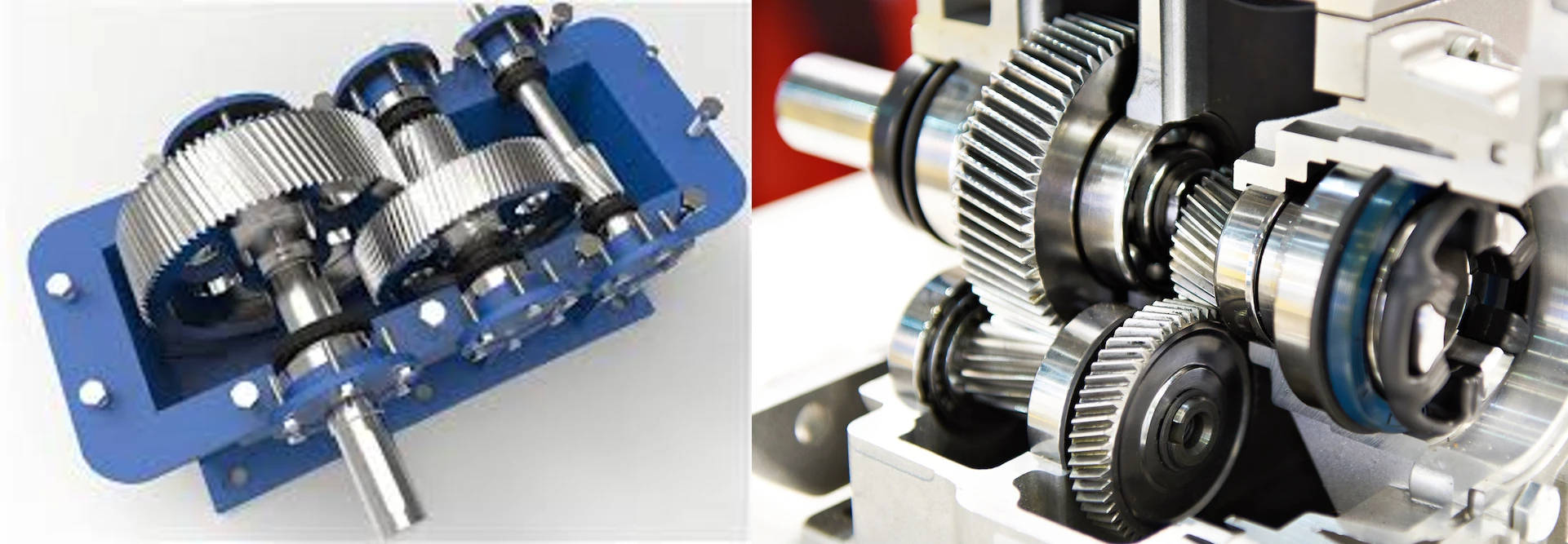
Assembled spiralgearkasse reducer units are also available for applications where a complete bolt-on drive is preferred over loose gears. Contact Korea Ever-Power with your drive requirements — torque, speed, duty cycle, and environmental conditions — for gear type and supply format recommendations.
Ofte stillede spørgsmål
When is a soft tooth flank helical gear the better choice over a carburized hard-tooth gear?
When the gearbox operating torque and speed fall within the fatigue limits of HB 220–280 material — which ISO 6336 or AGMA 2001 calculations can confirm — and when shaft alignment tolerance in the installation environment is moderate rather than precise, a soft tooth flank gear is often the more practical and cost-effective choice. The key disqualifiers for soft tooth flank are: very high pitch-line velocity (above 15–20 m/s), heavy shock loads, abrasive contamination in the lubricant, or a contact stress level that requires HRC 58+ surface hardness to meet the design service life target.
What is the correct run-in procedure for a soft tooth flank helical gear?
Run the gear pair at no load or reduced load (25–30% of rated torque) for a minimum of 20–40 hours. Then increase to 50–60% load for a further 20–40 hours before operating at full rated load. During the run-in period, check the lubricant for metallic particles by magnetic plug inspection every 8–10 hours. After run-in, drain and replace the oil to remove the fine wear particles generated during surface conforming. The tooth contact pattern should be inspected by tooth bluing before full-load operation to verify that the contact area covers at least 70% of the face width and 60% of the tooth height.
What lubrication grade is recommended for large soft tooth flank helical gears in metallurgy drives?
ISO VG 220 is the standard starting point for moderate-speed metallurgy auxiliary gearboxes at ambient temperatures of 15–40°C. For slower drives (below 5 m/s pitch-line velocity) or environments with wide temperature swings, ISO VG 320 provides better film thickness at high temperature while remaining pumpable at the lower end of the operating range. Synthetic PAO-based gear oil extends oil change intervals significantly compared to mineral oil and is recommended for gearboxes that are difficult to access for regular maintenance, such as those inside furnace aisles or beneath rolling mill stands.
How do I identify early-stage tooth wear before it becomes a failure risk?
For soft tooth flank gears, early warning signs include: increasing concentration of ferrous particles in the oil (detected by spectrometric oil analysis or magnetic plug inspection), rising gearbox housing temperature during steady-state operation, and audible changes in the mesh frequency tone. Visual inspection during planned maintenance should check for polishing scratches (normal after run-in), uniform pitting craters smaller than 1mm (early stage, monitor), and any tooth root cracking or large spall craters (requires immediate replacement). Vibration monitoring with an accelerometer at the gear mesh frequency provides the earliest detectable warning of tooth form deterioration before visual symptoms appear.
Can Korea Ever-Power manufacture a soft tooth flank gear to match a specific legacy drawing from a European mill builder?
Yes. Korea Ever-Power manufactures metric gears to any DIN, ISO, or AGMA standard. If your drawing specifies a European material grade equivalent (such as C45E per EN 10083-2, which corresponds to 45# steel in Chinese standard), we can confirm the material substitution and supply to the same mechanical property requirements. Drawings in German (DIN), Japanese (JIS), or English-language AGMA format are all accepted. For drawings with material specifications that require substitution, our technical team will confirm equivalence before manufacturing.
What is the difference between magnetic particle inspection and dye penetrant inspection for gear tooth surfaces?
Magnetic particle inspection (MPI) uses a magnetic field to attract fine iron powder to the edges of surface and near-surface cracks — it is sensitive to both open and closed surface defects on magnetic steel and is the standard method for detecting grinding cracks on gear tooth flanks. Dye penetrant inspection (DPI) requires cracks to be open at the surface to draw in the penetrant; it is effective for non-magnetic materials but less reliable for tight, closed grinding cracks on hardened steel surfaces. Korea Ever-Power uses fluorescent magnetic particle inspection on all ground tooth surfaces — the fluorescent particles provide better contrast under UV light than dry powder methods, allowing smaller cracks to be detected reliably.
Kundeanmeldelser
Lee Byung-chul, Gearbox Maintenance Lead, Pohang Integrated Steel (Q3 2024)
"We replaced the soft tooth flank helical gear sets in three slab caster auxiliary gearboxes. The gears from Korea Ever-Power matched the DIN 3962 class 6 requirement and the 45# QT hardness was confirmed at HB 238–252 on the test certificates. After the 40-hour run-in at reduced load, the contact pattern was clean and even across the full face width. No tooth noise or abnormal heating at rated load. Eight months in and the tooth surfaces still look good."
Choi Seong-min, Senior Maintenance Engineer, Gwangyang Steel Plant (Q4 2024)
"Ordered Mn=3 Z=128 left-hand soft tooth flank gears for our run-out table drive gearboxes. The permanent traceability markings were useful during our incoming inspection — we could confirm each gear's heat treatment batch and material certificate by the gear's own ID code. The Korean-language technical support during the specification review was also genuinely helpful. Delivery was 28 business days, which fitted our planned maintenance schedule."
Park Joo-young, Mechanical Procurement, Seoul Special Steel (Q2 2024)
"We had been sourcing these gears from a European supplier with 14-week lead times. Korea Ever-Power quoted six weeks and matched the DIN 3962 class 6 and magnetic particle inspection requirements specified in our drawing. The first delivery passed our incoming dimensional inspection without any deviations. We have since placed a blanket order covering the next two planned overhauls."
Zhang Wei, Metallurgy Equipment Engineer, Tangshan Steel (Q1 2025)
"We sent a worn gear from a continuous caster drive without a drawing — too corroded to read the original markings. Korea Ever-Power reverse-engineered from the sample and confirmed Mn=3, Z=128, 11.5° helix, DIN class 6. The replacement fitted perfectly. Response time between sending the sample and receiving the dimensional confirmation was four business days, which I did not expect for a gear this size."
Yoon Sang-jin, Plant Engineering Manager, Incheon Electric Arc Furnace (Q3 2024)
"Our EAF scrap conveyor gearboxes use large soft tooth flank helical gears in a moderately dusty environment. We had a quality concern after the first batch from a different supplier — some gears showed early pitting at 3 months. Switched to Korea Ever-Power for the replacement set. The MPI certificates and hardness records gave us confidence before installation. Now at seven months and the tooth surface shows the expected run-in polish without any pitting craters. Service team responded to our initial quality question within the same business day."
Yderligere information
| Redaktør | Cxm |
|---|
Relaterede varer
-

Dobbeltspiralformede tandhjul i industrielt legeret stål — Specialfremstillet legeringsmatrix i fuld kvalitet til præcisions sildebensmontering
-

Medicinsk dobbeltspiralgear — Fintgående sildebensgear i metalkvalitet til diagnostiske og militære præcisionsdrev
-

Dobbeltspiralformet gear til bilindustrien — POM / PA / PEEK finklingende sildebensgear i plast
-

Dobbeltspiralgear i stål — SS304 og SS316 rustfrit stål til korrosionsbestandige sildebensdrev
-

Spiralgear til drikkevarepakkemaskiner — AGMA klasse 8 til ultrastøjsvagt højhastighedspakkedrev
-
Krydsende spiralformet gear (skruegear) — Ikke-skærende akseltransmission med fleksible aksevinkler
-

Parallelaksede spiralgear — Højhastighedstransmission til tung belastning til parallelle akselsystemer
-
Slibede spiralformede gear — Præcisionsslebet 15° og 19°31′ for jævn transmission ved høj belastning