Why the Blank Manufacturing Method Determines the Gear’s Fatigue Ceiling
Two पेचदार गियर machined from the same steel grade — 42CrMo induction hardened to HRC 52, same module, same tooth count, same accuracy class — can have tooth root bending fatigue strength values that differ by 20–30% based solely on whether the blank was forged or machined from a round bar. The heat treatment brings both gears to the same surface hardness; the material test bar shows identical tensile strength and elongation for both. Yet the forged gear withstands more tooth root stress cycles before fatigue crack initiation, and absorbs more Charpy impact energy at −20°C. The difference lies entirely in the steel’s grain structure, which is set during the forging operation and cannot be subsequently changed by heat treatment or surface treatment.
For standard low-load drives this distinction may be academic — a hobbed soft tooth flank हेलिकल गियर in 45# QT from bar stock will outlast its design life comfortably if the duty cycle and loads are within the design envelope. For shock-loaded mining drives, high-cycle automotive gears, offshore-certified hoisting equipment, and railway traction — where tooth root fatigue and impact toughness are the binding constraints — the blank manufacturing method is a primary specification decision, not an afterthought.
Korea Ever-Power produces हेलिकल कट गियर in forged blanks for all applications above M8 and OD 200 mm, with in-house forging capability. For smaller gears (M1–M8, OD below 150 mm), bar stock machining is standard practice — the bar rolling process aligns the grain sufficiently for the light-duty loads that fine-pitch gears typically carry.
Forging — How Grain Flow Alignment Increases Fatigue Strength
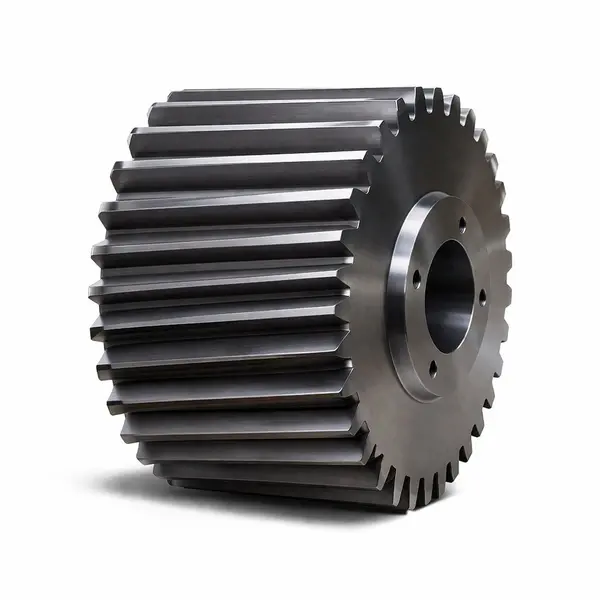
Carburized forged helical gear — the forging process aligns the steel grain flow parallel to the tooth root bending stress direction, creating a fibrous, directional microstructure that resists fatigue crack initiation and propagation more effectively than the random grain structure of a cast blank
What Happens During Closed-Die Forging
In closed-die forging of a हेलिकल गियर blank, a heated steel billet (typically 1150–1250°C) is placed in a die and struck by a press or hammer that forces the metal to flow into the die cavity. As the metal flows, the austenite grain structure elongates in the direction of metal flow — typically parallel to the dominant load direction. For a gear blank, the die is designed so that the metal flows circumferentially around the bore and radially toward what will become the teeth, creating a grain flow pattern that curves with the tooth profile at the root.
This curved, fibrous grain structure at the tooth root is the mechanical reason forged पेचदार गियर outperform their bar-machined equivalents. A fatigue crack initiating at the tooth root surface must propagate across grain boundaries — and in a forged gear where the grain boundaries run parallel to the tooth root fillet, the crack must change direction at each boundary, requiring more energy for each propagation step. In a bar-machined gear where the grain structure is random or runs perpendicular to the tooth root stress, the crack finds continuous grain boundary paths along which to propagate with less resistance.
Quantifying the Forging Advantage
The measured advantage of a correctly forged हेलिकल गियर blank over an equivalent bar-machined blank of the same material grade and heat treatment:
| संपत्ति | Forged Blank | Machined from Bar | Advantage of Forging |
|---|---|---|---|
| Tooth root bending fatigue strength (σ_F lim) | +15–25% above bar stock | आधारभूत | 15–25% more load cycles before fatigue crack initiation |
| Charpy impact toughness (at −20°C) | +20–35% above bar stock | आधारभूत | Absorbs more energy from shock loading events before fracture |
| Tensile strength (UTS) | Approximately equal (within 5%) | आधारभूत | Forging advantage is in fatigue and impact, not static strength |
| Freedom from internal voids/porosity | Forging closes all voids through plastic deformation | Bar rolling also compresses — but less reliably at the billet centre | Forging confirms UT-clean blank before any machining cost is invested |
| Dimensional consistency | Closer to finish blank — less machining allowance needed | Full bar OD must be turned to blank OD — more material waste | Forging reduces raw material cost per gear for large sizes |
Cast Helical Gears — When Casting Is the Correct Manufacturing Method

Hard tooth flank helical gear from a forged blank — for comparison, cast steel ring gears of the same module would appear as large segmented assemblies where forging the full OD is impractical
Casting is not simply the “inferior” alternative to forging — it is the correct manufacturing method for specific gear blank geometries and applications where forging is impractical or uneconomic:
Large Ring Gears and Gear Cases
Ball mill ring gears with OD of 3–10 metres cannot be forged as a single piece — forge presses capable of handling 20–100 tonne heated billets at this scale do not exist in commercial gear manufacturing. Ring gears at this size are cast as one piece or fabricated from cast steel segments that are welded together and stress-relieved. The cast steel grades used for ring gears — typically ASTM A148 Grade 90-60 or equivalent — have adequate fatigue strength for ring gear service because the ring gear rotates at low speed (0.5–5 RPM for ball mills) and each tooth experiences far fewer contact cycles per hour than the pinion. The pinion, which rotates faster, must be forged.
Complex Helical Gear Housing and Body Forms
Where a हेलिकल गियर has a complex body geometry — integral flanges, non-circular cross-section, multiple hub diameters — casting may be the most economical way to produce the blank net-shape, leaving only machining of mating surfaces and gear tooth cutting. Cast iron (GG25, ductile GGG40) and cast steel are commonly used for large, complex gear body forms in agricultural machinery, pulp and paper equipment, and large fan blade hub gears. These applications do not carry the shock loading or fatigue cycle count that would make forging worth its cost premium.
When to Reject Cast Blanks
Cast steel blanks are not appropriate for पेचदार गियर subjected to: (1) repeated shock loading (crushers, rolling mills, hammer mills); (2) sub-zero temperature service where Charpy impact toughness at −20°C or below is a certification requirement; (3) very high cycle fatigue (automotive transmission gears, high-speed compressor pinions) where the tooth root must survive 10⁸–10¹⁰ load cycles. In these applications, the internal porosity and shrinkage voids present in cast steel — even after rigorous UT inspection — provide crack initiation sites that significantly shorten fatigue life compared with void-free forged blanks.
Bar Stock Machined Helical Gears — When Simplicity Wins
For पेचदार गियर in module M1–M8, OD below 150 mm, in small quantities or where the load and cycle count are within the capabilities of bar-machined blanks, machining from hot-rolled or cold-drawn round bar is the standard and cost-effective approach. The continuous rolling process that produces round bar stock aligns the grain structure longitudinally along the bar axis — which is somewhat unfavourable for the tooth root bending stress direction (perpendicular to the bar axis in a conventional spur/helical gear), but the grain alignment is sufficiently consistent and the residual stresses from rolling are generally compressive at the surface, both of which benefit fatigue life over a true random-grain casting.
For prototype and single-piece हेलिकल कट गियर orders in M1–M8 at Korea Ever-Power, bar stock machining is the standard because the lead time is shortest — a qualified bar in the correct material grade is typically in stock, whereas a forging must be ordered to the blank drawing and heat treated before machining begins. For quantities above 5–10 pieces or for applications where the duty cycle approaches the fatigue limit of bar-machined blanks, the engineering team recommends moving to forged blanks.
Forged vs Cast vs Bar Stock — Complete Comparison for Helical Gear Blanks
| संपत्ति | Forged Blank | ढलवां इस्पात का खाली भाग | Bar Stock Machined |
|---|---|---|---|
| Grain flow at tooth root | Aligned with tooth profile — maximum fatigue resistance | Random — no alignment; voids present | Axial (perpendicular to tooth root stress) — suboptimal but acceptable for moderate duty |
| Internal voids / porosity | Eliminated by plastic deformation during forging | Present as shrinkage and gas porosity; reduced by risering and UT screening | Minimal in quality bar stock; billet centre may have minor segregation |
| Bending fatigue strength | Highest — grain alignment at tooth root | Lowest — random grain, potential voids | Intermediate — acceptable for standard industrial duty |
| Impact toughness (Charpy) | Highest — fibrous grain resists crack propagation | Lowest — random grain, voids act as crack initiators | Intermediate |
| Maximum practical blank OD | Up to ~1500 mm (equipment dependent) | Unlimited — only size requires segmented casting | Limited by bar stock rolling diameter (up to ~600 mm for quality gear steel) |
| Lead time impact | +2–4 weeks for forging and normalising before machining | +4–8 weeks for pattern, pouring, heat treatment | Fastest — bar stock typically in inventory |
| Cost vs bar stock | +10–30% for forging operation; saving on bar OD turning for large blanks | Lower raw material cost for large OD; high tooling (pattern) cost for small quantities | आधारभूत |
| Certification requirements met | All: mining, offshore, railway, pressure vessel, nuclear | Some: large ring gears, housing structures; not for high-shock power-path gears | Standard industrial and automotive (with appropriate UT screening for larger sizes) |
Quality Inspection for Helical Gear Forgings — What to Require

Korea Ever-Power quality inspection for forged helical gear blanks — UT, OES spectrometry, hardness survey, and dimensional verification before any machining cost is invested in a blank that may contain internal defects
Specifying a forged blank is necessary but not sufficient — a poorly executed forging can introduce laps, folds, segregation, or unfavourable grain flow that is worse than bar stock machining. The quality controls that confirm a forging is sound before machining investment begins:
100% UT scan of the forging on a grid pattern to identify internal voids, inclusions, and segregation. Acceptance criteria per ASTM A388 or EN 10228-3, depending on the customer’s material standard. UT is performed before final machining so that a rejectable indication can be identified before machining cost is invested in the defective blank.
A section cut from the forging is polished and acid-etched to reveal the grain flow lines. The etched section is photographed and reviewed to confirm grain flow runs parallel to the tooth root direction. Required for railway, offshore, and nuclear-qualified पेचदार गियर.
Optical emission spectrometer analysis of the actual forging material — not just acceptance of the mill certificate. Confirms the chemical composition of the forging heat matches the ordered grade, catching mix-ups between similar steel grades (e.g. 20CrMnTi vs 20CrNiMo) before heat treatment.
Brinell hardness readings at multiple positions on the forging face confirm uniform heat treatment response (QT or normalise) before gear cutting. Excessive hardness variation across the blank indicates incomplete heat treatment or grain size non-uniformity — either requires investigation before proceeding.
Korea Ever-Power — In-House Forging for Helical Gears Above M8
Korea Ever-Power’s forging capability covers all हेलिकल गियर blanks above M8 and OD 200 mm. In-house forging eliminates the subcontracting lead time and quality handover risk that arise when forging is outsourced to a separate supplier — Korea Ever-Power’s forge operators follow the same quality system and documentation standards as the gear machining and inspection departments. All forgings are UT-inspected before machining, with OES material verification and hardness survey as standard.
For हेलिकल कट गियर applications requiring third-party forging certification — offshore (DNV, BV, ABS), railway (KR, JR), or pressure equipment (PED) — Korea Ever-Power arranges classification society witness during forging and UT inspection, with society-stamped material certification included in the gear documentation package. As a direct हेलिकल गियर निर्माता handling forging through finished gear in-house, the documentation chain is complete and traceable without gaps between subcontractors.
अक्सर पूछे जाने वाले प्रश्नों
There is no universal size threshold — the decision depends on the application’s duty cycle, shock loading level, and fatigue life requirement. As practical guidance: for पेचदार गियर above M8, OD 200 mm, and any load-bearing (primary power path) application in mining, offshore, railway, or heavy industrial service, forged blanks are the standard. Below M8 and OD 150 mm in standard industrial or automotive duty, bar stock machining is appropriate. For highly shock-loaded applications (crushers, rolling mills, mine hoists) at any size, forging is required regardless of module or OD.
Standard mechanical test specimens (tensile bar, Charpy bar) are cut with the specimen axis aligned with the material’s grain direction in both cases — the longitudinal bar axis for bar stock, the dominant flow direction for forgings. Both specimens therefore test along the grain direction and give similar results. The fatigue difference appears at the tooth root, where the loading is transverse to the grain direction in a bar-machined gear but parallel to the grain direction in a forged gear. The standard test bar does not capture this difference. This is why specification documents for critical gears must explicitly require forged blanks — material certificates alone do not distinguish forging from bar stock.
No. Heat treatment modifies the transformation microstructure (martensite, bainite, pearlite percentages and grain size) but cannot change the fundamental grain flow pattern or eliminate porosity and shrinkage voids. A cast steel blank heat treated to HRC 58 still has the random grain structure and residual voids of the casting; a forged blank heat treated to the same HRC has the aligned grain flow and void-free structure of the forging. The heat treatment determines the hardness ceiling; the manufacturing method determines whether the material achieves the fatigue strength that the hardness implies.
Ball mill ring gears in OD above approximately 1500 mm are outside Korea Ever-Power’s current manufacturing range for finished gear products. Korea Ever-Power specialises in the forged हेलिकल गियर pinion side of the ball mill drive — the component that requires the highest fatigue performance and where in-house forging plus HÖFLER grinding adds the most value. Ring gear supply from specialised casting foundries can be arranged in coordination with the pinion order on request.
For small gears (M4–M10, OD below 200 mm): approximately 10–20% cost increase over bar stock machining, because the forging setup cost is divided over the blank volume. For medium gears (M12–M20, OD 200–500 mm): cost increase is typically 8–15%, as the material saving from nearer-net-shape forging partially offsets the forging operation cost. For large gears (OD above 500 mm): forging may actually reduce total cost versus bar stock — a 600 mm OD bar turned down to a 500 mm blank generates substantial swarf waste, whereas a forged blank starts nearer to finish dimensions. The question is rarely “is forging worth 15% more?” but rather “what is the value of the fatigue life improvement in this specific application?” For mining and offshore equipment, a premium of 15% on a gear that prevents 3 weeks of mill downtime is trivially justified.
Specify a Forged Helical Gear for Your Application
Submit your application type, power level, shock loading requirements, and any certification standards (DNV, KR, railway) with your enquiry. Korea Ever-Power’s engineering team confirms whether forged blanks are required and provides a complete specification with pricing and lead time within 24 working hours.
In-house forging · OES material verification · UT inspection · DNV/KR/railway certification available
संपादक: सीएक्सएम