Why Mining Applications Drive Helical Gear Design to Its Limits
Mining Stirnrad applications differ from standard industrial drives in five critical ways that must be addressed in the gear specification before module and material are selected:
Ball mill charge drop, crusher bite, and conveyor belt overload events create torque spikes of 2–6× rated torque lasting 0.1–2 seconds. The gear tooth root must absorb these without fracture — a requirement that drives material selection away from brittle hard-flank grades toward tough induction-hardened or QT-core configurations.
Ball mill ring gears in large grinding operations have OD up to 10 metres and module M25–M50. Mine hoist and conveyor main gears run M16–M30 with face widths of 500–1200 mm. These size ranges require forged blanks, specialised heat treatment, and in-place machining capability that most gear manufacturers cannot serve.
A ball mill gear failure in a remote open-cut gold mine in Western Australia or a copper mine in Mongolia means 2–6 weeks’ lead time for a replacement plus days of mill downtime. Production loss at 50–200 tonnes per hour of ore processing rapidly dwarfs any cost difference between premium and standard gear specification.
Mining environments produce rock dust, mineral slurry, and moisture that infiltrate seals, contaminate lubricants, and accelerate gear wear by abrasive particle ingestion. IP65 or higher housing ratings, large-volume oil sumps with adequate filtration, and regular oil sampling programs are engineering requirements, not optional upgrades.
Korea Ever-Power supplies schrägverzahnte Zahnräder for all mining application categories in this article, with in-house forging capability for large blanks and full material traceability documentation suitable for mining equipment supply chain requirements.
Ball Mill and SAG Mill Ring Gear and Pinion Drives
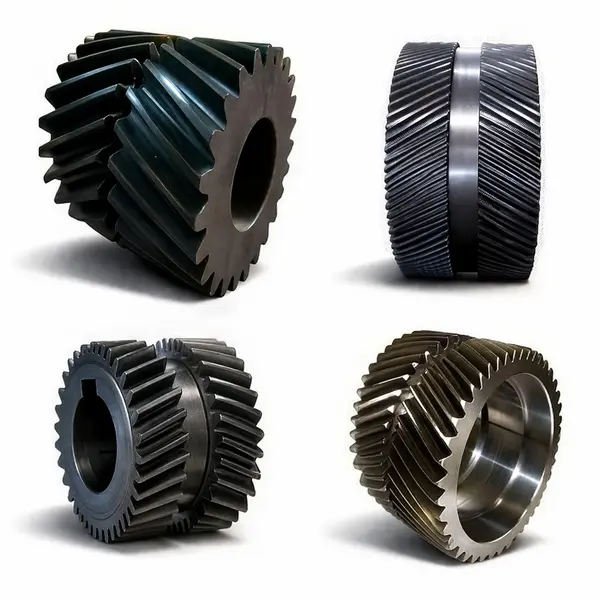
Double helical (herringbone) gear — the universal standard for ball mill and SAG mill main drives. The opposing helix sections cancel axial thrust, protecting the mill trunnion bearings from damage that would terminate mill operation and require weeks of unscheduled downtime
Why Ball Mills Must Use Double Helical (Herringbone) Gears
The most distinctive specification requirement of ball mill drives is the mandatory use of double helical (herringbone) gears — not single helical gears. The reason is structural: the ball mill drum rotates on two large trunnion bearings at either end of the drum. These bearings carry the full weight of the mill charge (ore plus steel balls), the drum structure itself, and any dynamic loads from the rotating charge. They are designed as radial load bearings — they have essentially no axial load capacity beyond what the mill end play allows.
A single-helical pinion driving the mill ring gear generates an axial thrust force F_a = F_t × tan β. At the typical helix angles used in mill pinion drives (β = 20–30°), this axial thrust would be 36–58% of the tangential force — a substantial continuous load acting on the trunnion bearing in the axial direction. Over time this would cause axial drift of the mill drum, uneven wear of the trunnion bearing surfaces, and ultimately trunnion bearing failure requiring mill disassembly. The double helical configuration eliminates this axial thrust entirely: the two helix halves’ axial forces cancel at the pinion body, leaving zero net axial force on the mill drive shaft and trunnion bearings. Engineering detail on herringbone design is at Doppel-Schrägverzahnung.
Ball Mill Pinion Specification Standards
| Mill Size / Application | Pinion Specification | Ring Gear Specification | Service Life Target |
|---|---|---|---|
| Small ball mill (3–5 m drum) | M16–M24, double helical, 20CrMnTi carburized HRC 58–62, DIN Class 6–7 | M16–M24, cast steel G35Mn, QT HB 220–280 | 5–8 years continuous duty |
| Large ball mill (5–8 m drum) | M24–M36, double helical, 17CrNiMo6 carburized HRC 58–62, DIN Class 5–7 | M24–M36, cast steel or fabricated, QT HB 240–320 | 8–12 years continuous duty |
| SAG mill (8–12 m drum) | M32–M50, double helical, 17CrNiMo6 carburized, forged blank mandatory | M32–M50, cast steel segments, QT HB 240–280 | 10–15 years with periodic regrinding |
Crusher Drive Helical Gears — Cone Crushers, Jaw Crushers and Gyratory Crushers

Hard tooth flank helical gear for crusher duty — induction hardened to HRC 50–55 on the tooth surface with a tough QT core. The hard surface resists abrasive wear from contamination; the tough core absorbs the 3–6× torque spikes that occur each time a rock enters the crusher chamber
The Crusher Gear Specification Challenge: Hard Surface + Tough Core
A cone crusher or jaw crusher creates rock entry shock events every 0.5–2 seconds in normal operation. Each event generates a torque spike of 3–6× the rated transmitted torque as the crusher jaws engage a rock fragment — a low-cycle impact fatigue condition that dominates the gear design over contact fatigue pitting. This shock loading requirement drives the crusher Stirnrad specification toward induction hardened 42CrMo (HRC 50–55) rather than carburized 20CrMnTi (HRC 58–62), despite the lower surface hardness. The reasoning is identical to rolling mill pinion selection: a carburized gear’s hard, relatively brittle case can initiate subsurface cracks under repeated high-energy impact at the case-core boundary. An induction-hardened gear’s shallower, tougher surface zone and high-toughness QT core (HB 280–320) absorb impact energy without crack initiation, at the cost of somewhat lower pitting fatigue life — which is not the limiting failure mode for crusher gears anyway.
Crusher Application Gear Specifications
| Crusher Type | Drive Gear Module | Material / Heat Treatment | Service Factor |
|---|---|---|---|
| Jaw crusher (small) | M10–M20 | 42CrMo induction HRC 50–55; QT core HB 280–320 | SF = 2.5–3.5 |
| Cone crusher (secondary) | M12–M24 | 42CrMo induction or 45# QT for eccentric drives | SF = 2.0–3.0 |
| Gyratory crusher (primary) | M20–M36 | 42CrMo induction HRC 50–55; forged blank mandatory | SF = 3.0–4.0 |
| Hammer mill / Impact crusher | M8–M20 | 42CrMo induction; extreme SF due to hammer impact | SF = 3.5–5.0 |
Overland Conveyor Drives in Mining — Long Distance, High Tonnage, 24/7 Operation
Mining overland conveyor Stirnradgetriebe in copper, iron ore, coal, and gold operations regularly run 5–25 km in length and their Stirnradgetriebe, transporting 1000–10,000 tonnes per hour of ore 24 hours per day. The drive gearboxes — typically 2–3 stage inline Stirnradgetriebe, 500–5000 kW per drive, multiple drives along the belt — are specified for a 20–25 year service life between major overhauls.
Key Differences from Standard Conveyor Gear Specification
Mining conveyor Schrägverzahnung face two challenges that standard industrial conveyor drives do not: the operating environment and the consequence of failure. Rock dust and ore dust infiltrate the Stirnrad housing seals over time, contaminating the gear oil with abrasive particles. ISO particle count maintenance (regular oil sampling and analysis, filtration to ISO 16/14/11 or better) is a non-negotiable maintenance requirement. If oil particle count is not maintained, the abrasive particles in the oil reduce the EHL film thickness ratio λ below the threshold for full film protection — initiating abrasive wear on the tooth flanks that can fail a gear in weeks rather than years.
The consequence of failure on a primary ore conveyor is severe: process plant stoppage while the conveyor is down means no ore feed to the crushing, grinding, and flotation circuits. At an ore processing rate of 2000 t/hour and gold equivalent recovery, this can represent several hundred thousand dollars per day of lost production. Service factors for mining conveyor Schrägverzahnung at Korea Ever-Power are therefore specified more conservatively than standard industrial conveyors: SF = 1.75–2.5 versus SF = 1.25–1.5 for comparable standard industrial belt conveyors.
Mine Hoist Drives — The Highest Consequence Application
Shaft-sinking and production hoists use Stirnrad drives to carry personnel and ore cages in vertical mine shafts at depths of 500–3000 m. The helical gear drives in mine hoisting systems — winding engine pinion stands, clutch-drive gearboxes, and drive shaft assemblies — are the highest consequence application in the mining industry because they carry human life. Regulatory requirements in Korean and most Asian mining jurisdictions specify:
- Forged blanks mandatory for all primary power path Schrägverzahnung, with grain flow confirmed by macro etch specimen and OES material verification on every heat.
- 100% ultrasonic inspection of forged blanks before gear cutting to confirm freedom from internal voids and segregation.
- Service factor SF = 2.5–3.5 applied to the maximum cage load including rope weight and dynamic acceleration factor.
- Redundant inspection documentation: material cert, UT report, gear analyser report, hardness survey, and dimensional CMM report — all retained for the gear’s service life plus 10 years.
- Third-party witness inspection available at material receipt, during forging, and at final inspection — Korea Ever-Power accommodates third-party witness inspection at any production stage.
The universal adoption of Schrägverzahnung in mining drive systems reflects a simple engineering reality: at the moderate pitch-line velocities of most mining drives (3–20 m/s), the helical tooth form delivers 25–50% more torque capacity in the same gear diameter compared with spur gears, with significantly lower noise and vibration. In an enclosed mining gearbox that may run 24/7 for a decade in a dusty, remote environment, the fatigue life advantage of a well-specified schrägverzahntes Zahnrad over a spur gear is measured in years of additional production before the first replacement is required. The Schrägverzahnungsprodukte supplied by Korea Ever-Power for mining cover every application in this article.
Mining Helical Gear Specification Summary
| Anwendung | Configuration | Modul | Material / HT | DIN-Klasse | SF |
|---|---|---|---|---|---|
| Ball mill pinion | Double helical | M16–M50 | 17CrNiMo6 carb. HRC 58–62 | Class 5–7 | 1.5–2.0 |
| SAG mill pinion | Double helical | M32–M50 | 17CrNiMo6 carb. HRC 58–62 (forged) | Klasse 5–6 | 1.75–2.5 |
| Cone crusher | Single helical | M12–M24 | 42CrMo ind. HRC 50–55 (forged) | Class 7–8 | 2.5–3.5 |
| Overland conveyor | Single helical | M8–M20 | 20CrMnTi carb. or 42CrMo ind. | Class 6–8 | 1.75–2.5 |
| Mine hoist | Single or double | M12–M32 | 17CrNiMo6 carb. HRC 58–62 (forged) | Class 5–7 | 2.5–3.5 |
| In-pit conveyor | Single helical | M6–M16 | 42CrMo or 20CrMnTi | Class 7–8 | 2.0–2.5 |
Korea Ever-Power — Helical Gear Supply for Mining Applications

Korea Ever-Power quality inspection for mining-grade Schrägverzahnung — 100% MPI, gear analyser report, CMM dimensional verification, and material traceability documentation retained for the gear’s service life
Korea Ever-Power’s manufacturing capability covers the full mining application range described in this article: double helical ball mill pinions in 17CrNiMo6 at module M16–M50 and OD up to 2500 mm; crusher drive schrägverzahnte Zahnräder in 42CrMo with induction hardening and forged blank supply; mine hoist gears with full regulatory documentation. As a direct Hersteller von Stirnrädern in Korea, Korea Ever-Power provides competitive lead times without the offshore supply chain risk that can extend replacement timelines on remote mining sites.
For maintenance and replacement of Schrägverzahnung in existing mining gearboxes — where the original drawing may not be available — Korea Ever-Power’s reverse engineering service measures all gear parameters from the worn component and produces an interchangeable replacement. Third-party witness inspection is accommodated at any stage, and all documentation is provided in English for international mining operators.
Häufig gestellte Fragen
The ball mill trunnion bearings cannot accept axial thrust from the main drive Stirnrad pinion — any axial load causes drum drift and bearing damage that requires mill disassembly. A single Stirnrad generates F_a = F_t × tan β; at β = 25°, this is 47% of the tangential force — catastrophic for the trunnion bearing over time. The double helical configuration cancels this axial force at the gear body, leaving zero net axial load on the drive shaft and trunnion bearings. For crusher, conveyor, and hoist drives, the axial thrust from a single helical gear is manageable with standard angular-contact bearings — so the simpler, lower-cost single helical is used.
Crusher tooth root failure under repeated shock loading is the critical failure mode — not pitting. Carburized 20CrMnTi at HRC 58–62 has a hard, relatively brittle case over a softer core; at the case-core boundary, repeated high-energy shock can initiate subsurface cracks that propagate to tooth fracture. Induction hardened 42CrMo at HRC 50–55 has a shallower, tougher surface zone and a QT core at HB 280–320 that absorbs impact energy without crack initiation. The lower surface hardness means shorter pitting life — but pitting is not the failure mode under crusher shock conditions, so this trade-off is correct for the application.
5–12 years depending on mill size, duty cycle, ore hardness, and lubricant maintenance quality. The dominant failure mechanism is progressive pitting of the Stirnrad pinion tooth flanks — starting at the pitch line and spreading gradually toward the tip and root. Regular oil sampling (monthly for critical mills) monitors water contamination, oxidation, and abrasive particle ingestion — the three lubricant factors that accelerate pitting initiation. When the pitted area on the Stirnrad flank exceeds approximately 5–10% of the tooth flank and significant spalling has begun, the pinion is replaced. Pinion replacement while the ring gear is still serviceable is common — the ring gear’s larger OD and lower rotational speed means each tooth sees far fewer contact cycles per hour than the pinion.
For small-to-medium ball mill Stirnrad pinions (M16–M30, OD below 600 mm): 6–10 weeks including forging, rough machining, carburizing, and HÖFLER grinding. For large SAG mill pinions (M32–M50, OD 600–1200 mm): 14–20 weeks. For emergency mill-down situations, Korea Ever-Power’s team confirms the fastest achievable schedule based on current material stock and production loading — and can prioritise a mining replacement ahead of lower-urgency orders when production loss justifies it. Contact with your required delivery date and the consequences of extended downtime.
Yes. Korea Ever-Power routinely supplies replacement Schrägverzahnung and double helical pinions for mining equipment from major manufacturers. The worn or failed gear is measured by gear analyser for all geometric parameters, OES spectrometer confirms the material grade, and an interchangeable replacement is produced to the same specification. OEM manufacturer names are referenced only for identification and interchangeability verification — Korea Ever-Power has no affiliation with those manufacturers. All supplied gears are Korea Ever-Power’s own product with Korea Ever-Power’s quality documentation.
Mining Gear Emergency or Scheduled Replacement?
Send your gear drawing, worn component, or key parameters — module, OD, face width, tooth count, material requirement and required delivery. Korea Ever-Power confirms production schedule and pricing within 24 working hours; third-party witness inspection accommodated at any stage.
Ball mill pinions · Crusher drives · Overland conveyor · Mine hoist · Double helical herringbone · M16 to M50
Herausgeber: Cxm