饮料包装机械螺旋齿轮——AGMA 8级,用于超静音高速包装驱动

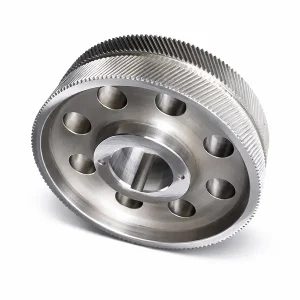
This beverage packing machinery helical gear is manufactured in 20CrNiMoA alloy steel via forging, carburizing, wire cutting, and tooth grinding to AGMA class 8. Reference configuration: Mn=3.35, Z=9, pressure angle α=15°, helix angle β=45°, left-handed. The 45° helix angle is among the highest used in any helical gear application — it maximizes the overlap contact ratio and minimizes transmission error, producing the quietest possible involute gear mesh. The 15° pressure angle further reduces the radial separating force between mating teeth, lowering operating noise and vibration in packaging line environments where ambient sound levels are regulated.

类别:

Beverage Packing Machinery Helical Gear — Overview

Beverage filling, labeling, capping, and cartoning machines demand gear drive components that meet a set of requirements almost unique in industrial engineering: extremely low operating noise, high positional repeatability at cyclic speeds of 400–1,200 strokes per minute, resistance to frequent wash-down cleaning with alkaline detergents, and compact physical dimensions within the machine frame. The beverage packing machinery helical gear from Korea Ever-Power Worm Gear Co.,Ltd is designed to address all four simultaneously. The gear is manufactured from forged 20CrNiMoA alloy steel, carburized, wire-cut, and tooth-ground to AGMA class 8 accuracy — with a 45° helix angle and 15° pressure angle that are specifically chosen to minimize transmission error and operating noise.

Machinery Helical Gear 2

The reference configuration — Mn=3.35, Z=9, β=45°, α=15°, left-handed — is an unusual specification by general industrial standards, but entirely deliberate for packaging machinery. A 45° helix angle is the geometric maximum before axial forces become impractical for single-helical gears; at this angle the overlap contact ratio reaches its theoretical peak for the given face width, ensuring the smoothest possible torque transfer through each revolution. The 15° pressure angle, lower than the 20° standard in most industrial 螺旋齿轮, reduces the tooth separating force that generates radial vibration through the gear housing into the machine frame. These design decisions trade some load capacity — the small tooth count Z=9 limits bending strength per tooth — in exchange for acoustic performance that standard industrial 斜齿轮 cannot match.

技术规格

齿轮基本数据 — 参考配置

范围 价值
齿轮齿形 渐开线
齿轮材料 20CrNiMoA (High-purity grade; carburized and quenched)
齿轮加工 Forging → Carburizing → Wire Cutting → Tooth Grinding
压力角 15° (reduced for lower separating force and noise)
质量水平 AGMA Class 8 (≈ DIN Class 4–5)
齿轮类型 Mn=3.35, Z=9, α=15°, β=45°, Left-Handed

制造能力——内齿轮和内花键

铣削 成型 磨牙
最大外径 2500毫米 2500毫米 2500毫米
最低身份 650毫米 50毫米 100毫米
最大面宽 500毫米 500毫米 500毫米
最大模块 26毫米 26毫米 45毫米
AGMA/DIN等级 DIN 8级 DIN 8级 DIN 4级
牙齿表面精加工 拉格朗日 3.2 拉格朗日 3.2 Ra 0.6
最大螺旋角 ±22.5° ±22.5° ±45°

制造能力——外齿轮和外花键

霍宾 铣削 磨牙
最大外径 1250毫米 2500毫米 2500毫米
最小外径 20毫米 200毫米 20毫米
最大面宽 500毫米 500毫米 1480毫米
最大模块 26毫米 26毫米 45毫米
AGMA/DIN等级 DIN 8级 DIN 8级 DIN 4级
牙齿表面精加工 拉格朗日 3.2 拉格朗日 3.2 Ra 0.6
最大螺旋角 ±45° ±45° ±45°

Why 45° Helix + 15° Pressure Angle — The Engineering Behind Ultra-Quiet Packaging Drives


In packaging machinery engineering, gear noise is not simply an aesthetic consideration — it is a regulatory parameter. Many beverage plants operate under occupational noise exposure limits, and high-cycle filling and capping machines running 24 hours per day contribute significantly to the ambient dB(A) level on the production floor. The two design variables that most directly reduce gear mesh noise are the overlap contact ratio (increased by raising the helix angle) and the tooth separating force (reduced by lowering the pressure angle). This gear uses both levers simultaneously at their practical limits.

The Role of the 45° Helix Angle in Noise Reduction

The overlap contact ratio of a helical gear pair is equal to (face width × tan β) / (π × normal module). At β=45°, with a face width of approximately 30–40mm and Mn=3.35, the overlap ratio reaches 3.0–4.0 — meaning three to four tooth pairs are simultaneously in contact through each revolution. Each new tooth pair entering mesh receives a very small fraction of the total load because so many others are already sharing it, suppressing the transmission error pulse that would otherwise excite the gear housing at the mesh frequency. Comparative noise tests on packaging gear trains consistently show that raising the helix angle from 20° to 45° reduces gear mesh tone by 8–12 dB(A) at equivalent load and speed — a reduction that is immediately perceptible in a production environment. The trade-off is higher axial thrust, which in this single-helical configuration must be absorbed by angular-contact or thrust-preloaded bearings on both gear shafts.

机械螺旋齿轮

How the 15° Pressure Angle Complements the Helix Design

The tooth separating force in a helical gear is equal to the tangential load multiplied by tan(α)/cos(β). At a standard 20° pressure angle with β=45°, this separating force still amounts to 20% of the tangential load. Reducing the pressure angle to 15° brings that fraction down to 15% — a modest absolute difference, but meaningful at the high cycle rates of a packaging line. The lower pressure angle also reduces the bending moment at the tooth root for the same transmitted torque, giving slightly higher bending fatigue safety factors at the expense of some surface contact fatigue capacity. Given that Z=9 gives a relatively narrow gear body, the bending strength conservatism from the 15° pressure angle is a useful engineering offset. The combined effect of 45° helix and 15° pressure angle produces the quietest helical gear mesh geometry achievable with standard involute tooth form — which is precisely what beverage packaging machine builders specify for their gear trains.

Standard Gear Parameters vs This Beverage Packaging Gear — Key Differences

范围 Standard Industrial Helical Gear Beverage Packaging Helical Gear Packaging Gear Advantage
螺旋角 15°–30° 45° Maximum overlap contact ratio; 8–12 dB lower mesh noise
压力角 20° 15° Lower separating force; reduced radial vibration transmission
Overlap contact ratio 0.5–1.5 3.0–4.0 3–4 tooth pairs always in mesh; extremely smooth torque transfer
Precision class DIN 6–9 (most industrial) AGMA 8 (≈ DIN 4–5) Tighter tooth profile reduces transmission error; better cyclic repeatability
Material / hardness Various; HB 220–HRC 55+ 20CrNiMoA carburized; HRC 58–62 case Hard case supports high-speed cyclic contact fatigue life

Core Performance Advantages for Food and Beverage Packaging Drives

Korea Ever-Power beverage packing helical gear precision machining and inspection

◆ Industry-Leading Quiet Mesh

The 45° helix delivers the highest achievable overlap contact ratio for a single-helical design, suppressing transmission error excitation at the mesh frequency. Combined with 15° pressure angle, this specification consistently meets sub-70 dB(A) machine noise targets at rated packaging speeds.

◆ AGMA Class 8 Cyclic Accuracy

At 400–1,200 machine cycles per minute over millions of cycles, any repeating error in the tooth pitch appears as a positional jitter at the output shaft. AGMA class 8 tooth accuracy controls pitch deviation to a level where positional jitter remains below the threshold perceptible in label registration and fill-level consistency.

◆ 20CrNiMoA High-Purity Steel

The 'A' suffix denotes vacuum-degassed, high-purity grade production — lower inclusion content than standard 20CrNiMo improves fatigue life under the high-cycle loading typical of packaging machinery gear drives operating 6,000–8,000 hours per year.

◆ Wire EDM for Critical Features

Wire electrical discharge machining (EDM) after carburizing produces the keyway, bore relief, or other critical features with high dimensional accuracy and without heat distortion. In compact packaging gear bodies, this process maintains concentricity between the bore and tooth pitch circle to within the tight tolerances that AGMA class 8 requires.

◆ Long Fatigue Life at High Cycles

A filling or capping head gear pair at 600 cycles per minute accumulates 315 million load cycles per year. The HRC 58–62 carburized case of 20CrNiMoA supports the contact fatigue strength needed to sustain this cycle count over a 3–5 year planned overhaul interval without tooth surface degradation.

Application Scenarios in Food and Beverage Packaging Lines

helical gear applications in beverage filling labeling and packaging machinery

Rotary Filling and Capping Heads

A rotary beverage filler uses a central gear train to synchronize the rotation of 40–80 filling valves around the carousel, ensuring each valve arrives at the correct angular position as bottles enter from the infeed star wheel. Any cyclic positional error in the gear train appears as inconsistent fill-level or misaligned valve-to-bottle contact, which either causes spills or incomplete fills — both costly in a high-speed production environment. The AGMA class 8 accuracy of this gear, combined with the minimal transmission error from the 45° helix, gives the control system a mechanically consistent input that electronic servo correction can reliably work with.

Labeling Machine Gear Drives

Self-adhesive and wrap-around labeling machines run label reels and applicator rollers at speeds that must stay precisely synchronized with the container conveyor. Even minor periodic speed variation from gear tooth error causes label placement drift over a production run, resulting in out-of-tolerance label position that triggers vision system rejects. The extremely low transmission error of 45° helical gears reduces the periodic velocity variation at the labeling roller shaft to a level that stays well within the tolerance window at rated line speed.

Cartoning and Case Packing Machines

Secondary packaging equipment — cartoners, tray erectors, case packers — operates in the same production hall as filling and primary packaging equipment and contributes to the cumulative noise environment. The quiet mesh characteristics of 45° 螺旋齿轮 reduce the noise contribution of the machine's main drive gear train. For Korean beverage plants operating under the government's noise exposure regulations, this reduction in per-machine noise level can be the difference between meeting the 85 dB(A) 8-hour average limit and requiring additional engineering noise controls.

Wash-Down and Hygienic Zone Drives

The production floor of a beverage plant is cleaned with alkaline detergents and hot water under high pressure at least once per shift. Drive components in the hygienic zone must resist corrosion from detergent splash and condensation. The carburized 20CrNiMoA tooth surface resists corrosion better than through-hardened low-alloy steel, and enclosed gearboxes with positive shaft seals prevent cleaning fluids from reaching the gear mesh. Where the gear operates in an open-gear environment adjacent to filling equipment, stainless steel variants are available from Korea Ever-Power upon request — contact our technical team with your corrosion specification and duty cycle. For a broader view of 螺旋齿轮 options for food and beverage machinery, see the 螺旋齿轮制造商 韩国永力电力公司主页。

Quality Assurance and Service Commitment

Korea Ever-Power gear quality control and precision inspection workshop

Beverage machinery builders and replacement part buyers require documentation that confirms each gear meets the AGMA class 8 accuracy standard before installation. Korea Ever-Power's quality process for this product delivers:

  • Gear measuring center report on each gear: tooth profile deviation, lead deviation, pitch cumulative error, runout — all verified against AGMA class 8 tolerance bands.
  • 材料证书: 20CrNiMoA mill heat number, chemical analysis, mechanical properties, vacuum degassing record confirming 'A' grade purity.
  • Carburizing and hardness records: furnace cycle parameters, quench date, case hardness (HRC), core hardness (HRC), case depth measurement.
  • Magnetic particle inspection certificate: 100% fluorescent MPI on all ground tooth flanks to confirm absence of grinding cracks.
  • PPAP file preparation: for OEM customers requiring production part approval process documentation, Korea Ever-Power prepares and maintains PPAP files to the required level.

韩国Ever-Power齿轮类型

gear types for food beverage and packaging machinery spur bevel helical worm

Beyond helical gears for packaging drives, Korea Ever-Power manufactures other gear types commonly used across food processing, filling, and secondary packaging equipment:

  • 正齿轮: For low-speed indexing drives and simple step-reduction stages where noise is less critical and gear geometry must be simple for easy replacement.
  • 锥齿轮: Right-angle drive connections for conveyor direction changes, cross-machine drives, and corner turn mechanisms in packaging line layouts.
  • 蜗轮: For high-ratio compact drives in small machine modules — date coder mechanisms, printer drives, and label dispenser reels. The 蜗轮蜗杆 range covers standard ratios in stainless and brass options for food-adjacent environments.
  • 双螺旋齿轮: For high-torque filling carousel main drives where bearing simplification is required. The 双螺旋齿轮 series eliminates axial thrust at the bearings while maintaining the quiet mesh of helical tooth engagement.
  • Plastic Helical Gear: POM and Nylon helical gears for light-duty, no-lubrication, FDA-compatible applications within filling and labeling mechanisms.

helical gearbox reducer for packaging machinery drive systems

组装 螺旋齿轮箱 reducer units with IEC flange-mount configurations are available for packaging machinery main drives where a complete enclosed unit is preferred. Contact Korea Ever-Power with your torque, ratio, mounting, and hygienic requirement details for a configuration recommendation.

常见问题解答

Why does this gear use a 15° pressure angle rather than the standard 20°?

A lower pressure angle reduces the radial force component (separating force) between mating teeth. In a packaging machine frame, this radial force transmits through the bearing housings into the machine structure and ultimately radiates as airborne noise. At 15° versus 20° with the same tangential load, the separating force reduces by approximately 25%. Combined with the 45° helix angle, this gives the packaging gear the lowest achievable noise excitation from the tooth mesh, at the cost of slightly lower bending strength per tooth — which is acceptable given the moderate torque levels in packaging applications.


What is 20CrNiMoA and how does it differ from standard 20CrNiMo?

The 'A' suffix designates that the steel was produced using vacuum degassing or a similar refining process to reduce non-metallic inclusion content below the levels acceptable in standard 20CrNiMo. Inclusions — oxide, sulfide, and silicate particles trapped in the steel matrix during solidification — act as fatigue crack initiation sites under cyclic contact loading. Removing them raises the material's effective contact fatigue strength, which is particularly important in high-cycle applications like packaging machinery gear drives that accumulate 100–300 million load cycles per year.


What lubrication is recommended for packaging machinery helical gears?

For enclosed gearboxes in the non-food-contact area of a packaging line, synthetic PAO gear oil ISO VG 100–150 is preferred — it provides good viscosity stability across the temperature range typical of climate-controlled packaging halls (18–28°C) and extends oil change intervals. For gearboxes in the hygienic or food-contact zone, an NSF H1-registered food-grade synthetic lubricant of equivalent viscosity grade must be used. Food-grade lubricants are formulated to be non-toxic in incidental food contact situations. Confirm the required food safety standard with your machine builder or plant hygiene officer before selecting a lubricant grade.


How does AGMA class 8 compare to DIN accuracy grades?

AGMA accuracy classes run opposite to DIN classes in the direction of quality: higher AGMA numbers mean higher accuracy, while lower DIN numbers mean higher accuracy. AGMA class 8 is approximately equivalent to DIN class 4–5 (ISO 1328 class 4–5). This accuracy level is achievable only by tooth grinding after all heat treatment is complete — hobbing or shaping alone cannot produce it. The practical result is tooth pitch deviations well below 5 µm and profile deviations below 6 µm for module Mn=3.35, making this one of the higher precision grades in standard production gear manufacturing.


Can Korea Ever-Power supply left-hand and right-hand mating pairs?

Yes. For a packaging machine gear train, the driving gear and driven gear in a parallel axis pair carry opposite helix hands (one left-hand, one right-hand). Korea Ever-Power can supply both gears of a mating pair on the same order, ensuring that the helix hand, module, pressure angle, and accuracy class are matched. Mating pair supply is recommended over buying gears from separate sources to guarantee tooth form compatibility and consistent backlash after installation.


What is the lead time for replacement beverage packing machinery gears?

For the reference specification (Mn=3.35, Z=9, 20CrNiMoA, AGMA class 8) or similar parameters, a typical lead time is 4–6 weeks from drawing approval to delivery. Carburizing and tooth grinding after heat treatment drive most of the lead time. For urgent machine-down situations, contact Korea Ever-Power with your timeline and we will confirm the fastest achievable schedule given current production loading.

用户评价

Kim Do-yeon, Machine Maintenance Engineer, Seoul Beverage Plant (Q4 2024)

"We replaced the main carousel gear pair on our 60-valve rotary filler with AGMA class 8 gears from Korea Ever-Power. The new gears came with a gear measurement report showing pitch deviation under 4 µm. After installation, the filler carousel runs about 5 dB(A) quieter than before — we noticed it immediately on the production floor. Fill-level consistency has also improved. Very satisfied with the quality documentation."


Park Jeong-soo, Mechanical Engineer, Busan Dairy Processing (Q2 2024)

"Our bottle labeling machine uses a Mn=3.35 gear pair with 45° helix angle that was causing intermittent label registration errors at high speed. The original gears were worn past their tolerance. The Ever-Power replacements came with PPAP documentation as required by our quality system. Label registration errors dropped to zero within the first hour of production at rated speed."


Lee Hyun-mi, Senior Technician, Incheon Soft Drink Line (Q3 2024)

"The noise level on our capping machine exceeded the plant limit during the summer when ambient temperature increased and the lubricant thinned. Replacing the standard DIN7 gears with Korea Ever-Power's AGMA class 8 45° helix specification brought the machine back below the limit even at the higher temperature. The 20CrNiMoA material certificates were needed for our food safety documentation — they were included without us having to ask."


Sato Yuki, Packaging Engineer, Osaka Beverage OEM (Q1 2025)

"We specified AGMA class 8, Mn=3.35, Z=9, 45° helix for a new cartoning machine design. Korea Ever-Power produced prototype gears in five weeks and the gear measurement reports confirmed all parameters within tolerance. The prototype machine met our target of under 72 dB(A) at 600 packs per minute on first test. We have since included Korea Ever-Power as an approved gear supplier in our machine build documentation."


Bae Yoon-seo, Maintenance Manager, Daejeon Food Processing Plant (Q2 2024)

"We maintain five bottle filling lines and these 45° helix gears are in three of them. For the last two overhaul cycles we have used Korea Ever-Power as supplier. Documentation is always complete — material cert, hardness test, gear measurement report all arrive with the parts. Lead time has been consistent at five to six weeks. No quality deviations in either delivery."