เฟืองเกลียวคู่ — แรงผลักตามแนวแกนเป็นศูนย์ สำหรับระบบขับเคลื่อนเพลาขนานแรงบิดสูง
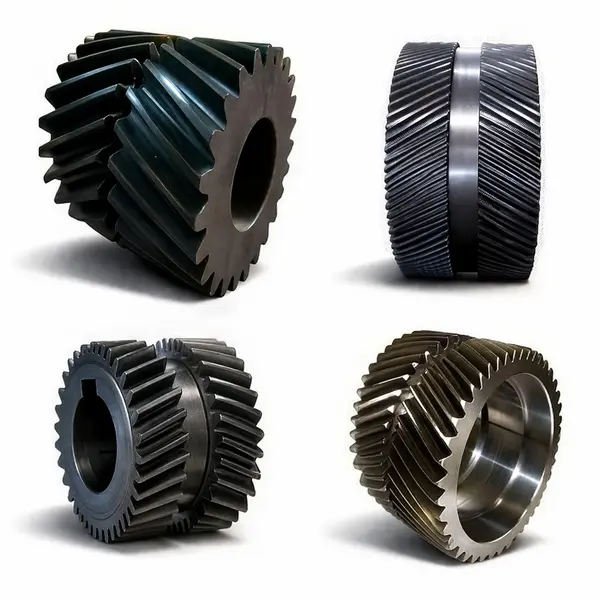
Double helical gears pair left-hand and right-hand helices on one gear body, eliminating axial bearing load entirely. Helix angles up to 45° — versus the 15°–20° limit of single-helical designs — raise the contact ratio and smooth out torque transmission under heavy loads. Standard applications include crane gearboxes, marine reduction drives, and power turbines. Korea Ever-Power Worm Gear Co.,Ltd manufactures custom modules, bore diameters, and material grades. Send your drawing or cross-reference part number for a direct quote.
What Is a Double Helical Gear
เอ เฟืองเกลียวคู่ consists of two opposing helical sections — one left-hand helix and one right-hand helix — machined onto the same gear blank at identical twist angles. The arrangement is sometimes called a herringbone gear, though strictly speaking a herringbone has no central groove while a เฟืองเกลียวคู่ has a relief groove separating the two helix halves. Both transmit rotational motion between parallel shafts. The fundamental advantage is that the axial thrust generated by the left-hand section and the right-hand section act in exactly opposite directions, canceling one another within the gear body. Supporting bearings therefore carry radial force only, which significantly extends bearing service life and reduces shaft deflection under heavy torque.
Because axial thrust is no longer a constraint, เฟืองเกลียวคู่ can operate with helix angles between 20° and 45°. Single เฟืองตัดเกลียว are generally limited to 15°–20° before bearing thrust loads become problematic. A wider helix angle increases the overlap ratio — more tooth pairs share the load at any instant — which raises the power capacity of a given gear size and smooths vibration at high speeds. These properties make them the standard choice for crane gearboxes, marine reduction drives, industrial turbines, and rolling mill drives where both torque density and quiet operation matter. Korea Ever-Power Worm Gear Co.,Ltd supplies เฟืองเกลียวคู่ in alloy steel, carbon steel, and nodular cast iron, with hobbed or ground tooth finishes to match the required ISO accuracy class.
Technical Specifications: Double vs Single Helical Gear
The comparison below covers the principal engineering differences between single and เฟืองเกลียวคู่. Understanding these distinctions is essential when evaluating which type suits a specific power transmission requirement.

| เฟืองเกลียวเดี่ยว | เฟืองเกลียวคู่ |
|---|---|
| A single helical gear has teeth inclined in any one direction (either left-hand helix or right-hand helix). | The double-helical gear consists of two identical gears jointed on the same axis and teeth in opposite directions (one has a left-hand helix, and the other has a right-hand helix). |
| Single helical gears develop axial thrust force and exert the same on corresponding bearings. It also generates radial force. | The resultant thrust force developed in double helical gear is zero. Thus it exerts no axial load on bearings. But radial force exists as usual. |
| The power transmission capacity of a single helical gear is comparatively low. | Double helical gears can transmit more significant power for exact size and module. |
| Single helical gears are cheaper. | Double helical gears are costlier as design and fabrication are complex and time-consuming. |
| High precision is usually not desired during the alignment of the gears. | Two helical gears must be aligned precisely; otherwise, thrust force will not balance properly, resulting in negative vibration. |
| Because of thrust load, a high helix angle cannot be used. Helix angle for single helical gear usually varies from 15° to 20°. | Due to the canceled thrust load, a high helix angle (20°–45°) can be advantageously used in double helical gears. |
| The efficiency of single helical gear is comparatively low. | Double helical gears can provide higher efficiency. |
| The bearing span (distance between two bearings) is short. | The bearing span is longer due to a central relief groove in between two gears. |
| Single helical gears are suitable for mechanical drives or power transmission requirements, where each application usually requires a unique design for powers, speeds, and configuration. | Double helical gears are suitable for high power transmission requirements in cranes, marine drives, or turbines. |
How Double Helical Gears Work
Gradual Tooth Engagement
Unlike straight-cut spur gears where the full tooth width contacts simultaneously and creates a sharp load spike, a เฟืองเกลียว tooth makes contact at one edge first, then the contact line travels diagonally across the tooth face as the gear rotates. This progressive engagement distributes the impact energy over a measurable arc of rotation, producing significantly lower noise and vibration. In the double-helix format, both tooth sets remain continuously engaged through each revolution, which essentially doubles the active contact length compared to a single-helical gear of the same face width. The practical result is a smoother output torque curve and less dynamic load amplification at the mesh frequency — a property valued in turbine gearboxes and high-speed reduction stages.
Thrust Cancellation Inside the Gear Body
ทั้งหมด เฟืองตัดเกลียว produces an axial thrust component equal to the tangential force multiplied by the tangent of the helix angle. In a standard single-helical gear at 20° helix angle, this thrust can reach 36% of the tangential load — a significant bearing load at high torque. The double-helix design routes equal and opposite thrust forces through the gear body itself. The central relief groove provides the clearance required to cut both sets of teeth independently without interference and ensures the thrust from one half does not simply transfer to the groove wall. The net axial force reaching the shaft and bearings is effectively zero, allowing the use of simpler and less expensive radial bearings rather than thrust-capable angular-contact or tapered-roller assemblies.

Double Helical Gear vs Spur Gear — Side-by-Side Comparison
A common question when specifying a gearbox is whether a เฟืองเกลียวคู่ or a เฟืองตรง is the better fit. The answer depends on speed, noise tolerance, axial space, and load requirements. The table below compares the two on the parameters that typically drive the decision.

| พารามิเตอร์ | เฟืองเดือย | เฟืองเกลียวคู่ |
|---|---|---|
| Noise level | Higher — full tooth contact occurs at once | Low — gradual diagonal contact on both helix halves |
| แรงผลักตามแนวแกน | ไม่มี | None (internally canceled) |
| Load capacity (same size) | ปานกลาง | High — higher contact ratio distributes load |
| ประสิทธิภาพการส่งผ่าน | 98%–99% | 97%–99% (slight friction from helix sliding) |
| ความซับซ้อนในการผลิต | ต่ำ | High — dual helix requires precise alignment and special tooling |
| Speed range | Low to moderate | Low to high — well suited for high-speed heavy-load applications |
For moderate speeds and simpler gearboxes, a standard spur gear may be the economical choice. Where noise matters, loads are heavy, or shaft and bearing configurations need simplification, เฟืองเกลียวคู่ provide clear technical advantages at a higher but justifiable cost. For a precise selection recommendation based on your torque, speed, and duty cycle, contact Korea Ever-Power directly.
Core Performance Advantages
⚙ Zero Axial Bearing Load
Paired helices cancel axial thrust internally. Bearings handle radial force only, which lowers operating temperature and extends service intervals.
⚙ Higher Helix Angle Range
Helix angles of 20°–45° are practical, compared to 15°–20° for single-helical types. A larger angle raises the overlap ratio and load capacity for the same gear diameter.
⚙ Low Noise and Vibration
Continuous diagonal tooth engagement on both helix halves suppresses mesh-frequency noise — a critical factor in marine cabins, turbine halls, and industrial facilities with noise regulations.
⚙ High Power Density
For identical module and center distance, a double helical gear transmits more torque than its single-helical equivalent, allowing more compact gearbox designs without sacrificing capacity.
⚙ Extended Tooth Life
Load shared across a larger number of simultaneously engaged teeth reduces individual tooth root stress and Hertzian contact pressure, slowing pitting and fatigue progression.
⚙ Bearing and Shaft Simplification
With axial loads eliminated, standard deep-groove or cylindrical roller bearings are often sufficient. This reduces procurement complexity and lowers the cost of spare bearing inventory.

Typical Applications

Marine Reduction Gearboxes
Shipboard gearboxes must reduce diesel or gas-turbine output speed to propeller shaft speed — often a ratio of 5:1 to 15:1 — while transmitting several thousand kilowatts. เฟืองเกลียวคู่ are standard in this duty because the zero-thrust characteristic allows the gearbox to be built without the heavy thrust collars required in single-helical arrangements. The low noise level also matters: noise transmitted from the gearbox through the hull structure affects crew comfort and, in naval vessels, acoustic signature.
Power Generation Turbines
Steam and gas turbines spin at 3,000–15,000 rpm and must be geared down to 1,500 rpm or 1,800 rpm for standard generator coupling. At these speeds, even small unbalanced forces cause significant vibration and noise. เฟืองเกลียวคู่ are the industry default for turbine step-down gearboxes because the self-balancing helix arrangement accommodates the high speeds and continuous full-load duty cycles typical of utility-scale generators. Carburized and ground tooth finishes in ISO accuracy class 5 or better are common specifications for this duty.
Heavy-Lift Cranes and Industrial Hoists
In gantry cranes, ship-loader drives, and large industrial hoists, the gearbox experiences frequent load reversals as the load is raised, held, and lowered. Reversing load direction in a gear mesh can excite backlash-related noise and impact stresses. The continuous tooth engagement of เฟืองเกลียวคู่ reduces these transient impact loads by keeping more teeth in mesh at all times, and the zero-thrust characteristic means that load reversals do not flip the direction of axial force at the bearings. The result is reduced gearbox maintenance costs over the operating life of the crane.
Selection Parameters for Double Helical Gears
Specifying a เฟืองเกลียวคู่ correctly requires confirming the following parameters before placing an order. Providing complete data upfront avoids design iterations and delays.
- Power and torque: Rated power (kW) and peak torque (Nm) at the gear mesh, including service factor for load type (smooth, moderate shock, heavy shock).
- Speed: Input and output shaft speeds (rpm); this determines the pitch line velocity and influences the required accuracy grade.
- Module and tooth count: Confirm the normal module (Mn), helix angle (typically 20°–35° for standard double-helical applications), and number of teeth on pinion and gear.
- Center distance and bore: Fixed center distance if retrofitting; bore diameter, keyway, and shaft fit tolerance for both gear and pinion.
- Material and hardness: Carbon steel (45# or 40Cr), alloy steel (20CrMnTi for carburized applications), or nodular cast iron (QT600-3). Specify surface hardness (HRC) or core hardness (HB) as required by the duty cycle.
- Accuracy class: ISO 1328 or AGMA class. ISO 6–8 for general industrial; ISO 4–6 for high-speed or precision drives. This determines whether hobbing or grinding is required for the tooth finish.
Related Gear Products and Drive Components
- ➜ Helical Gearbox: A fully assembled parallel-shaft helical gear reducer that packages the gear set with housing, bearings, and seals. Suitable where a bolt-on drive unit is preferred over loose gears. See our เฟืองตัดเกลียว range for matching components.
- ➜ เฟืองตัวหนอน: For right-angle drives with high reduction ratios in a single stage, a เฟืองตัวหนอน may pair with a helical first stage to achieve high overall ratio while keeping the output shaft perpendicular. Contact us for pairing recommendations.
- ➜ Double Helical Gear (Herringbone Variants): For applications requiring higher contact ratio without a central groove, herringbone-profile เฟืองเกลียวคู่ without a relief groove are available. Inquire for specifications.

คำถามที่พบบ่อย
What is the difference between a double helical gear and a herringbone gear?
Both types combine left-hand and right-hand helix sections. The key structural difference is a central relief groove: double helical gears have a groove between the two sets of teeth, which provides tool clearance during manufacturing. Herringbone gears have no groove — the left and right teeth meet at the center — offering slightly higher face width utilization but requiring more specialized production equipment.
Why do double helical gears produce zero axial thrust?
Each helix section generates an axial force component. In the double-helix design the two sections have identical helix angles but opposite hand. The forces are equal in magnitude and opposite in direction, so they cancel within the gear body. The shaft and bearings experience only the net resultant, which is zero axial force.
What helix angle is standard for double helical gears?
The most common range is 20°–35° for general industrial applications. Angles up to 45° are used in high-speed turbine gears where maximum contact ratio is required. Below 20°, the advantage over single-helical gears diminishes; above 45°, manufacturing tolerances become very demanding and tooth-sliding friction increases.
What materials are available for double helical gears?
Korea Ever-Power supplies double helical gears in 45# carbon steel (general-purpose, normalized or quenched and tempered to HB 220–280), 40Cr alloy steel (induction hardened, HRC 48–54 surface), and 20CrMnTi (carburized and quenched to HRC 58–62 case). Nodular cast iron QT600-3 is available for large, cost-sensitive gears where weight is not critical.
How do I calculate the correct module for my load?
Module selection starts from bending strength (Lewis equation) and contact fatigue (Hertzian stress) calculations using the design torque multiplied by the application service factor. Providing your input power (kW), input speed (rpm), gear ratio, and material specification allows Korea Ever-Power's engineering team to recommend a module and face width that meet the required safety factors per ISO 6336 or AGMA 2001.
How often should double helical gears be lubricated?
For splash-lubricated enclosed gearboxes, the oil should be sampled and analyzed every 2,000–4,000 operating hours and changed at the first sign of contamination or viscosity degradation. ISO VG 220–320 gear oil is typical for moderate-speed applications; synthetic PAO lubricants are recommended for high-speed or high-temperature duty. Spray lubrication for open gears requires fresh lubricant application approximately every 8 operating hours depending on load and environmental conditions.
Can Korea Ever-Power supply double helical gears as replacements for existing gearbox components?
Yes. Provide the existing gear's module, number of teeth, helix angle, bore diameter, face width, and keyway dimensions. If you have a gear drawing or can measure the worn gear directly, our engineering team will verify all parameters and confirm dimensional compatibility before manufacturing. Replacement gears with matching tooth profiles and bore sizes can be produced without requiring gearbox housing modification in most cases.
What is the typical lead time for custom double helical gears?
For standard module and material combinations, 3–5 weeks from drawing confirmation is typical for quantities of 1–10 pieces. Large gears (above 1,000 mm pitch diameter) or those requiring carburizing and grinding may need 6–10 weeks. Expedited manufacturing for urgent replacement parts can be arranged; contact us with your schedule constraints for a firm commitment.
รีวิวจากลูกค้า
Kim Jae-won, Gearbox Maintenance Engineer, Incheon Shipyard (Q3 2024)
"We replaced a worn double helical gear set on our main reduction gearbox — module 8, 42 teeth, 20CrMnTi. The new gears from Ever-Power fit without any housing modification and the surface finish on the teeth was visibly better than the originals. Gearbox noise at full shaft speed dropped noticeably. Parts arrived in four weeks, which kept our drydock schedule intact."
Park Sung-hoon, Senior Mechanical Engineer, Gwangyang Steel Complex (Q4 2024)
"Ordered two double helical pinions for our rolling mill drive. The bore and keyway tolerances were exactly to our drawing — no fitting work required. We have been running them for about six months now with no unusual wear or vibration. Pricing was fair and the technical team answered our material questions quickly."
Lee Min-jun, Plant Engineer, Busan Power Station (early 2025)
"Needed a helical gear set for a steam turbine step-down gearbox as part of a scheduled overhaul. The gears required ISO class 6 accuracy and carburized teeth. Ever-Power supplied with a CMM inspection report attached to the parts. Everything passed our incoming inspection. No surprises."
Nguyen Van Minh, Procurement Manager, Haiphong Port Authority (Q2 2024)
"We sourced double helical gears for three gantry crane gearboxes. Lead time was five weeks, which matched our maintenance window. Shaft fit was H7/k6 as specified. The teeth showed no signs of pitting after 800 operating hours under full port-load duty. Good value compared with European-origin replacements."
Choi Dong-ho, Procurement Director, Ulsan Heavy Industries (Q1 2025)
"We compared three suppliers. Ever-Power was not the cheapest but their technical documentation was the most complete — material certificates, hardness test records, and a full dimensional report per gear. For critical rotating equipment, that level of traceability justifies the price difference. Will order again."
Yamamoto Kenji, Mechanical Division, Osaka Turbine Manufacturer (Q3 2024)
"Prototype order for a custom double helical pinion with a 30° helix angle and a non-standard bore. Ever-Power confirmed the design was manufacturable, suggested a small modification to the relief groove width to ease machining, and delivered in four weeks. The prototype ran clean in our test rig from the first hour."
ข้อมูลเพิ่มเติม
| บรรณาธิการ | ซีเอ็กซ์เอ็ม |
|---|
สินค้าที่เกี่ยวข้อง
-

เฟืองเกลียวคู่เหล็กกล้า — สแตนเลส SS304 และ SS316 สำหรับชุดขับเคลื่อนก้างปลาที่ทนต่อการกัดกร่อน
-
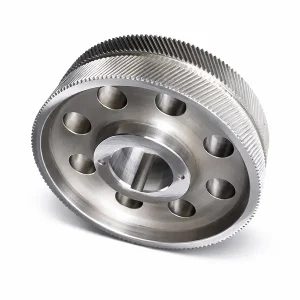
เฟืองเกลียวคู่แบบอุตสาหกรรม — มุมเกลียว 30° สำหรับเครน ปั๊มของเหลว และระบบขับเคลื่อนเรือ
-

เฟืองเกลียวคู่เหล็กกล้าคาร์บอน
-
เฟืองเกลียวคู่สำหรับเครื่องจักรหนัก — เหล็กหล่อแบบฟันอ่อน QT เกรด ISO 8–9
-

เฟืองเกลียวสำหรับเครื่องจักรบรรจุเครื่องดื่ม — มาตรฐาน AGMA Class 8 สำหรับการขับเคลื่อนบรรจุภัณฑ์ความเร็วสูงที่เงียบเป็นพิเศษ
-

เฟืองเกลียวข้างฟันอ่อน — มาตรฐาน DIN Class 6 สำหรับระบบขับเคลื่อนเสริมของโรงรีดเหล็ก
-

เฟืองเกลียวคาร์บูไรซ์สำหรับเครื่องจักรเหมืองแร่ — เหล็ก 18CrNiMo6 ขึ้นรูปขึ้นรูป มาตรฐาน DIN Class 6 สำหรับระบบขับเคลื่อนอุตสาหกรรมที่มีแรงกระแทกสูง
-
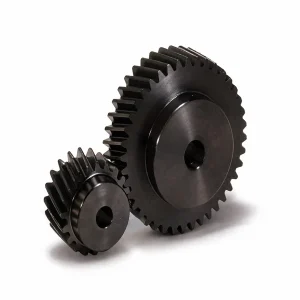
เฟืองเกลียวเจียรละเอียด — เจียรละเอียด 15° และ 19°31′ เพื่อการส่งกำลังที่ราบรื่นและรับน้ำหนักสูง