Ελικοειδή γρανάζια ενανθράκωσης μηχανημάτων εξόρυξης — σφυρήλατα 18CrNiMo6, κατηγορίας DIN 6 για βιομηχανικούς κινητήρες υψηλής αντοχής
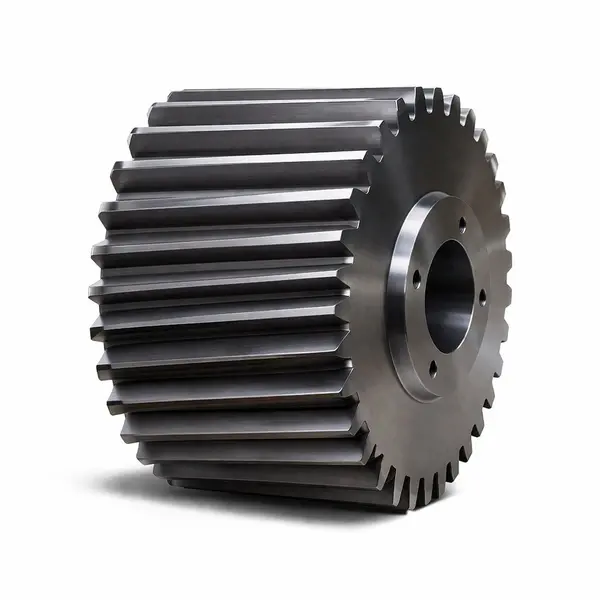
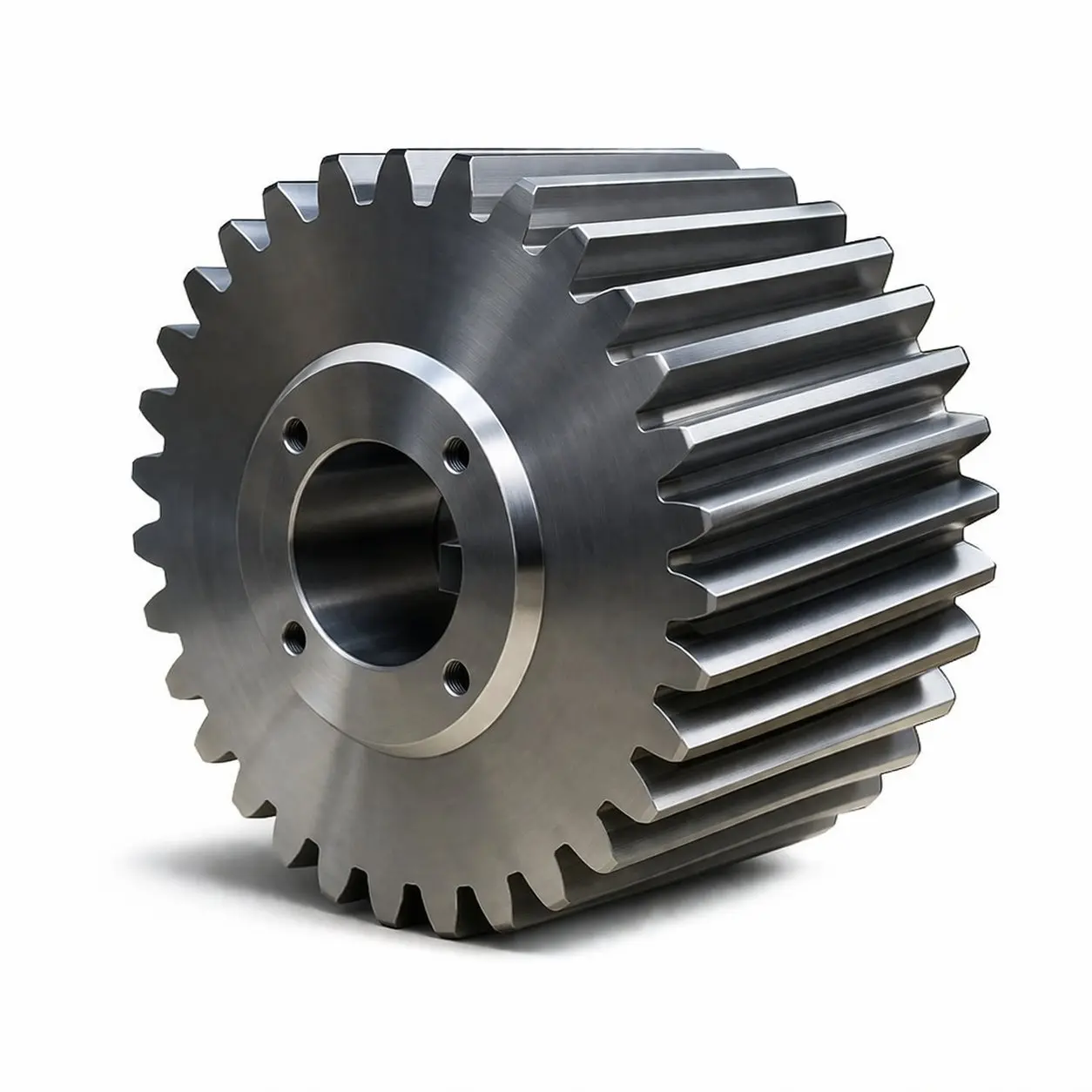
This forged carburized helical gear is made from 18CrNiMo6 alloy steel, with the tooth form M=9, Z=33, pressure angle 20°, helix angle 8°, profile shift x=0.2, right-handed. Manufacturing sequence: forging → carburizing → plane and internal grinding → tooth grinding → wire cutting. Finished to DIN 3962 class 6, tooth surface Ra 0.6 after grinding. Manufacturing capability covers external gears up to OD 2500mm and module 45mm (tooth grinding), internal gears up to 2500mm O.D. Designed for mining gearboxes, rolling mills, and other high-impact continuous-duty industrial drives.
Mining Machinery Carburized Helical Gear — Overview
The mining machinery carburized helical gear from Korea Ever-Power Worm Gear Co.,Ltd is a heavy-duty power transmission component manufactured specifically for the demanding shock and abrasion conditions found in underground mining equipment, surface excavators, conveyor gearboxes, and ore-processing machinery. The combination of 18CrNiMo6 nickel-chromium-molybdenum alloy steel, forged blank production, and a full carburizing-and-grinding manufacturing sequence produces a gear with a hard, wear-resistant case over a tough, shock-absorbing core — exactly the mechanical property profile that mining drives require. Standard spur or through-hardened ελικοειδή γρανάζια do not provide this combination: a hard-through gear is brittle under impact, while a soft gear wears rapidly under abrasive dust contamination. Case carburizing solves both problems simultaneously.
The reference gear for this product is a right-hand ελικοειδές γρανάζι κοπής with module M=9, 33 teeth, an 8° helix angle, 20° pressure angle, and a profile shift coefficient of x=0.2. This tooth geometry has been selected to balance tooth bending strength with smooth engagement characteristics for the gearbox input speed ranges typical of mining machinery. Korea Ever-Power's manufacturing capability extends to external gears up to 2,500mm outer diameter and 45mm module for tooth-ground finishes, covering the full size range of mining and metallurgical gearbox applications from compact shearer drives to large mill pinion gears. For customers who need a direct ελικοειδή γρανάζια κοπής replacement for an existing worn component, reverse engineering from sample gear or drawing is a standard service.
Product Specifications and Manufacturing Capabilities
Gear Basic Data — Reference Configuration
| Παράμετρος | Αξία |
|---|---|
| Gear Tooth Shape | Involute |
| Υλικό γραναζιών | 18CrNiMo6 |
| Gear Process | Forging, carburization, plane and internal grinding, tooth grinding, wire cutting |
| Γωνία πίεσης | 20° |
| Quality Level | DIN 3962 Κλάση 6 |
| Τύπος γραναζιού | M=9, Z=33, a=20°, β=8°, x=0.2, Right-Handed |
Manufacturing Capabilities — Internal Gears and Internal Splines
| Παράμετρος | MILLING | SHAPING | TOOTH GRINDING |
|---|---|---|---|
| Maximum O.D. | 2500 mm | 2500 mm | 2500 mm |
| Minimum I.D. | 650 mm | 50 mm | 100 mm |
| Maximum Face Width | 500 mm | 500 mm | 500 mm |
| Maximum Diametral Pitch | D.P. 1 | D.P. 1 | DP 0,5 |
| Maximum Module | 26 mm | 26 mm | 45 mm |
| AGMA / DIN Level | DIN Class 8 | DIN Class 8 | Κλάση DIN 4 |
| Tooth Surface Finishing | Ρα 3,2 | Ρα 3,2 | Ra 0,6 |
| Maximum Helix Angle | ±22.5° | ±22.5° | ±45° |
Manufacturing Capabilities — External Gears and External Splines
| Παράμετρος | HOBBING | MILLING | TOOTH GRINDING |
|---|---|---|---|
| Maximum O.D. | 1250 mm | 2500 mm | 2500 mm |
| Minimum O.D. | 20 mm | 200 mm | 20 mm |
| Maximum Face Width | 500 mm | 500 mm | 1480 mm |
| Maximum Diametral Pitch | D.P. 1 | D.P. 1 | DP 0,5 |
| Maximum Module | 26 mm | 26 mm | 45 mm |
| AGMA / DIN Level | DIN Class 8 | DIN Class 8 | Κλάση DIN 4 |
| Tooth Surface Finishing | Ρα 3,2 | Ρα 3,2 | Ra 0,6 |
| Maximum Helix Angle | ±45° | ±45° | ±45° |
Carburizing and Heat Treatment — Why 18CrNiMo6 Matters for Mining Drives

18CrNiMo6 is a case-hardening alloy steel with chromium and nickel additions that give it two properties essential for mining gear applications: high core toughness and deep hardenability. The chromium content (1.5–1.8%) improves hardenability, ensuring that carburizing produces a consistent hardened case even on large-diameter gear bodies. The nickel content (1.4–1.7%) maintains core ductility after quenching, so the gear can absorb the shock loads from ore crusher drives or conveyor overloads without brittle fracture through the tooth root.
The Carburizing Process in Sequence
The complete manufacturing sequence for this carburized helical gear is: forging → rough machining → carburizing (gas atmosphere furnace, case depth 1.5–2.5mm for module M9) → quenching → stress-relief tempering → plane and internal grinding (to correct heat-treatment distortion on reference surfaces) → tooth grinding (to DIN class 6 final accuracy, Ra 0.6 tooth flank) → wire cutting (for keyway, spline, or relief features requiring tight dimensional tolerances after hardening). The tooth grinding after heat treatment is the critical step: it removes the profile error introduced during carburizing distortion and brings the tooth flank to the final accuracy class, ensuring that the gear operates at its designed contact ratio and load distribution from the first hour of service.
Forging vs Casting — Why Forged Blanks Are Specified for Mining Gears
Forged helical gear blanks have grain flow that follows the contour of the gear cross-section, which aligns the material's strongest direction with the principal stress direction in the tooth root. Cast blanks, by contrast, have random grain orientation and often contain internal shrinkage porosity or inclusions that act as stress concentration points under cyclic loading. For mining drives that experience regular shock loads — such as a conveyor belt starting under full load, or a jaw crusher encountering an oversize rock — a forged blank can absorb significantly more impact energy before crack initiation at the tooth root than a cast blank of identical nominal composition. Korea Ever-Power specifies forged 18CrNiMo6 blanks as standard for all mining and heavy-industry ελικοειδή γρανάζια above module M6 and for any gear subjected to impact loading, regardless of module.

Gear Failure Modes in Mining Environments — and How Carburizing Addresses Them

Surface Pitting and Spalling
Pitting is the progressive formation of small craters on the tooth flank surface under cyclic Hertzian contact stress. It begins at sub-surface crack nucleation sites — often just below the depth where maximum shear stress occurs under normal contact loading. A high-hardness carburized case (HRC 58–62) raises the allowable contact stress limit significantly compared to a through-hardened gear (HRC 48–54), pushing the fatigue threshold well above the normal operating stress range. The residual compressive stress introduced by the quench process further suppresses crack propagation, so carburized gears resist pitting initiation for considerably longer service intervals than alternative hardening methods.
Tooth Root Bending Fatigue
The tooth root is the highest-stress location in a gear under load — bending stress peaks at the root fillet. In mining drives with frequent start-stop cycles and load reversal (such as reversing conveyors), the tooth root experiences fully reversed bending stress, which reduces the allowable stress amplitude to roughly half the one-way bending fatigue limit. The combination of a hard case (which raises the surface fatigue limit) and a tough core (18CrNiMo6 with 1.4% Ni provides good fracture toughness even at lower temperatures) gives the best combination of surface resistance and bulk toughness available from a case-hardening alloy. Shot peening of the root fillet after grinding can further increase the root fatigue limit by introducing beneficial compressive residual stresses — available on request.
Abrasive Wear from Contaminated Lubricant
In underground mining environments, fine mineral dust inevitably enters the gear housing through seals, particularly on conveyor drives and heading machine gearboxes. Mineral particles harder than the tooth flank surface act as a three-body abrasive between the mating tooth flanks. A carburized case at HRC 58–62 is harder than most common rock minerals (quartz has a Vickers hardness of approximately 1100 HV; the carburized case reaches 700–750 HV) — so the carburized surface resists abrasive wear far better than a hobbed-and-normalized gear at HB 220–280. Combine this with a fine-ground tooth surface (Ra 0.6) that holds a stable oil film more readily than a rough-cut surface, and the result is markedly reduced wear rates in contaminated lubricant conditions.
Core Performance Advantages
◆ High Impact Resistance
18CrNiMo6 with 1.4% nickel content maintains core toughness after quenching. The forged blank's aligned grain structure absorbs sudden shock loads from crusher overloads and conveyor start-up impulses without initiating cracks at the tooth root.
◆ High Surface Hardness HRC 58–62
The carburized and quenched case reaches HRC 58–62 at the tooth flank surface, raising the allowable Hertzian contact stress limit and resisting both surface pitting and abrasive wear from contaminated lubricant in underground mining environments.
◆ DIN Class 6 Accuracy Post-Grinding
Tooth grinding after heat treatment corrects carburizing distortion and achieves DIN 3962 class 6 accuracy with tooth flank Ra 0.6. This accuracy level supports the designed contact ratio from the first hour of operation and reduces dynamic load amplification at operating speeds.
◆ Large-Scale Manufacturing Capability
External gears up to 2500mm O.D. and module 45mm (tooth grinding) can be produced in-house. This scale covers the largest mining and metallurgical gearbox pinions without outsourcing critical operations that could affect dimensional consistency.
◆ Full Traceability Documentation
Each gear is supplied with a material certificate (mill heat number, chemical analysis, mechanical properties), hardness test records, and a dimensional inspection report. For safety-critical mining applications, this traceability package meets the documentation requirements of major mining OEM qualification programs.
Industrial Applications for Carburized Helical Gears
Underground Mining Machinery
Continuous miners, longwall shearer drives, and heading machines transmit hundreds of kilowatts through compact gearboxes operating in environments with coal dust, mineral particles, and limited maintenance access. The carburized hard case on the tooth flanks resists abrasive wear from dust contamination, while the tough 18CrNiMo6 core handles the shock loads from cutting through rock strata. Gearboxes designed to replaceable specification (drop-in pinion and wheel sets) are a standard supply format — provide the existing gear's drawing or worn sample for a matched replacement.
Ore Processing and Mill Drives
Ball mill and SAG mill gearboxes use large-module ελικοειδή γρανάζια — module M12 to M45 is common in this sector — running continuously under high torque with periodic shock from uneven ore feed. The external tooth grinding capability to module 45mm and OD 2500mm covers the full size range of these mill pinions. For the primary drive stage, carburized and ground gears in 18CrNiMo6 match the service life targets set by mill operators who calculate cost per tonne of ore processed as a key maintenance metric.

Metallurgical Rolling Mill Gearboxes
Steel and aluminum rolling mills subject their gearboxes to large cyclic torque variations as each billet or slab enters and exits the roll gap. The transient torque spike at entry can reach three to five times the mean running torque. Carburized helical gears in 18CrNiMo6 are the standard specification for rolling mill pinion stands and roughing mill gearboxes because the material's combination of high core toughness and surface hardness handles both the peak entry torque and the prolonged steady-state rolling loads. Find the full range of industrial-grade ελικοειδή γρανάζια κοπής and options at κατασκευαστής ελικοειδών γραναζιών Korea Ever-Power.
Our Service Process — Before, During, and After Production
Pre-Production
- ▸ Customer provides detailed drawings or sends worn gear for reverse engineering
- ▸ Korea Ever-Power evaluates drawing, communicates technical and quality questions, and issues quotation
- ▸ Unresolved technical questions addressed via direct communication before PPAP file preparation
In-Process
- ▸ Detailed technical questions arising during production communicated and resolved promptly
- ▸ Traceability marking applied at each process stage for full manufacturing audit trail
- ▸ Complete production flow and transportation packing plan prepared and documented before shipment
After-Sales
- ▸ Application performance monitored following delivery
- ▸ Quality complaints acknowledged within 24 hours; 8D report issued within 48 hours; on-site support available if required
- ▸ Continuous process improvement to reduce lead times and improve dimensional consistency
- ▸ Annual customer visits abroad to maintain technical, quality, and commercial alignment

Τύποι Εξοπλισμού από την Κορέα Ever-Power
Korea Ever-Power Worm Gear Co.,Ltd manufactures a comprehensive range of gear types beyond helical gears. Whether your application requires a different configuration or a complete drive system combining multiple gear types, our team can assist:

- ⬡ Εργαλείο ώθησης: Straight-cut teeth for low-to-moderate speed parallel shaft drives where noise is not a primary concern. Simple geometry and lower manufacturing cost than helical types.
- ⬡ Γωνιακός οδοντωτός τροχός: Transmits power between intersecting shaft axes — typically at 90°. Widely used in differential drives, right-angle gearboxes, and hand tool drives.
- ⬡ Εργαλείο σκουληκιών: Right-angle non-intersecting shaft drives with high single-stage reduction ratios. The ατέρμονα κοχλία series covers standard center distances and reduction ratios with self-locking capability.
- ⬡ Διπλό ελικοειδές γρανάζι: For heavy-duty parallel shaft drives requiring zero axial thrust at the bearings. The διπλό ελικοειδές γρανάζι series is used in marine, turbine, and rolling mill gearboxes where thrust bearing cost and complexity must be minimized.
- ⬡ Εσωτερικό γρανάζι δακτυλίου: Internally toothed annular gears for planetary gearboxes and compact epicyclic stages used in drilling heads, mill drives, and compact industrial reducers.
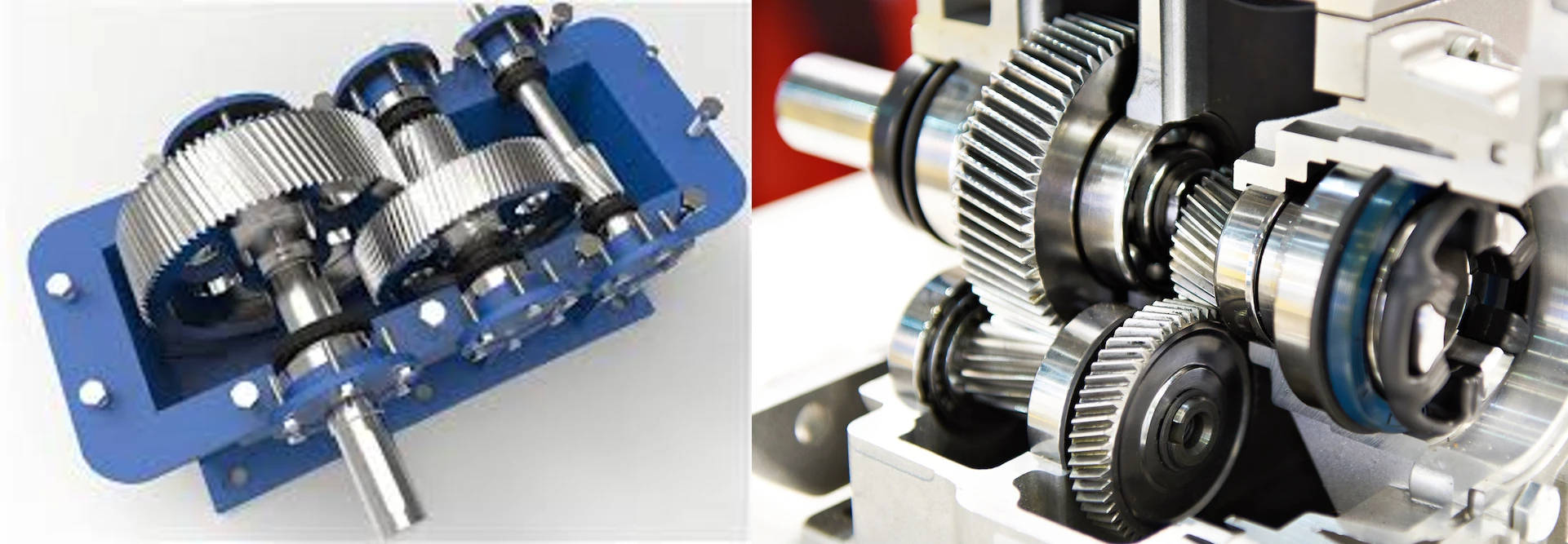
For applications requiring a complete assembled drive rather than loose gears, Korea Ever-Power also supplies ελικοειδές κιβώτιο ταχυτήτων reducer units. Contact us with your torque, speed, ratio, and mounting configuration requirements for gear type selection and supply format recommendations.
Συχνές ερωτήσεις
Why is 18CrNiMo6 preferred over 20CrMnTi for mining gear applications?
Both are case-hardening steels that achieve similar surface hardness after carburizing. The key difference is nickel content: 18CrNiMo6 contains 1.4–1.7% Ni, which significantly improves core toughness at low temperatures — relevant for mining equipment operating in cold climates or deep mines with cool rock temperatures. 20CrMnTi (no nickel) is an economical alternative for moderate-temperature moderate-shock applications. For severe impact loading or sub-zero operation, 18CrNiMo6 is the specification standard in the European and Korean mining industry.
What carburizing case depth is appropriate for mining helical gears?
Case depth is generally specified as 15–25% of the tooth root thickness, which for module M9 corresponds to a case depth of approximately 1.5–2.5mm after grinding. Too shallow a case leaves insufficient hardened material after tooth grinding removes the distorted outer layer; too deep a case reduces the core toughness zone and can make the tooth root more brittle under impact. The specific case depth should be confirmed in the technical drawing for each gear to ensure it accounts for the anticipated grinding allowance.
Can I provide only a worn gear sample with no drawing?
Yes. Korea Ever-Power specializes in reverse engineering damaged and worn gears. Send the worn gear and we will measure tooth pitch, module, number of teeth, helix angle, pressure angle, bore diameter, keyway dimensions, face width, and any hub features. A completed dimensional report and a manufactured replacement can be provided from the measurement data without requiring an original drawing. For severely worn gears where critical dimensions cannot be reliably measured, a mating gear (if available and less worn) greatly assists the reverse engineering process.
What documentation is included with each carburized helical gear shipment?
Standard documentation package includes: material certificate (heat number, chemical composition, mechanical properties), hardness test records (case hardness and core hardness at specified sampling points), dimensional inspection report (critical dimensions verified against drawing tolerances), and a packing list. For customer qualification programs that require additional documentation — PPAP, first article inspection reports, non-destructive testing records — these can be arranged at the quotation stage.
How do I maintain a carburized helical gear in a mining gearbox?
Use an extreme-pressure (EP) gear oil rated for the operating temperature and pitch line velocity of your gearbox — ISO VG 220–460 for most mining gearboxes, with viscosity selected based on operating temperature. Sample and analyze the oil every 1,000–2,000 operating hours or quarterly, whichever is sooner. Replace oil when particle count, acid number, or viscosity drift exceeds your maintenance thresholds. Inspect tooth flanks visually at each oil change — early-stage pitting (shallow, regular craters) is manageable; deep spalling or tooth root cracks are signals to replace the gear before secondary damage to the housing or bearings occurs.
What is the lead time for large carburized helical gears?
For gears up to approximately module M12 and OD 500mm from drawing confirmation, 4–6 weeks is typical. Larger gears (module M12–M45, OD up to 2500mm) require 8–14 weeks depending on material procurement and heat treatment scheduling. Urgent replacement orders for mining equipment downtime situations can be prioritized — contact Korea Ever-Power with your timeline and we will confirm the fastest achievable delivery.
Κριτικές πελατών
Kim Sang-il, Chief Maintenance Engineer, Gangwon Mining Co. (Q4 2024)
"We sent a worn shearer gearbox pinion to Korea Ever-Power for reverse engineering — module M9, 18CrNiMo6 spec. They sent back a dimensional report within four business days and delivered the replacement gear in seven weeks. The replacement dropped straight into the housing — no fitting work. After six months of three-shift operation the tooth surface shows normal polishing but no pitting. Much better than the previous supplier we were using."
Park Hyun-jin, Gearbox Engineer, Pohang Steel Mill (Q3 2024)
"Ordered carburized helical pinions for two roughing mill gearboxes undergoing scheduled rebuild. Module M12, 18CrNiMo6, DIN class 6, with full PPAP documentation required by our maintenance program. Korea Ever-Power delivered all PPAP documents with the gears. Dimensional reports were thorough — profile, lead, pitch, hardness all within spec. The gears have been running 400 hours since installation without incident."
Choi Yeon-su, Equipment Maintenance Director, Jeonnam Ore Processing (Q2 2024)
"Our ball mill pinion was showing early-stage pitting after about 18 months. The original OEM supplier quoted 16 weeks and a price that seemed high. Korea Ever-Power quoted 11 weeks and about 22% less, with the same 18CrNiMo6 material and DIN class 6 specification. We went with them. The new pinion arrived with a full material certificate and hardness records. Now at 14 months of service and the tooth surface still looks clean."
Tran Van Hung, Technical Manager, Quang Ninh Coal Mining (Q1 2025)
"We operate continuous miners in underground coal seams. Gearbox gear sets last on average about eight months here before we replace them as a precaution. The carburized helical gears from Korea Ever-Power have matched that cycle on the first replacement set, which is what we needed — consistent service life so our planned maintenance schedule stays predictable. Documentation package was complete and the on-site technical contact at Korea Ever-Power responded to our questions within a few hours each time."
Bae Myung-jin, Procurement Specialist, Seoul Heavy Industries (Q3 2024)
"First order with Korea Ever-Power was a trial — two carburized helical gears for a conveyor drive gearbox rebuild. The gears arrived with hardness test records and a coordinate measurement report. Everything was within drawing tolerances. We have since placed three more orders with them for the same application. Lead time has been consistent at about six weeks from drawing approval."
Σχετικά προϊόντα
-

Διπλό ελικοειδές γρανάζι αυτοκινήτου — POM / PA / PEEK Πλαστικά γρανάζια ψαροκόκαλου λεπτού βήματος
-
Βιομηχανικά διπλά ελικοειδή γρανάζια — Γωνία έλικας 30° για γερανούς, αντλίες υγρών και συστήματα πρόωσης πλοίων
-

Διπλό ελικοειδές γρανάζι από ανθρακούχο χάλυβα
-
Διπλό ελικοειδές γρανάζι βαρέων μηχανημάτων — Χυτό χάλυβα με μαλακή οδόντωση, QT, ISO βαθμού 8–9
-

Ελικοειδής οδοντωτός τροχός με σκληρά δόντια για ατμομηχανή τρένου υψηλής ταχύτητας — Κλάση DIN 6 για συστήματα μετάδοσης κίνησης έλξης
-

Ελικοειδής οδοντωτός τροχός με μαλακά δόντια — Κλάση DIN 6 για βοηθητικούς κινητήριους μηχανισμούς κίνησης ελασματουργείου
-
Διασταυρούμενος ελικοειδής οδοντωτός τροχός (κοχλιωτός οδοντωτός τροχός) — Μη τεμνόμενος άξονας μετάδοσης με εύκαμπτες γωνίες άξονα
-
Διπλό ελικοειδές γρανάζι — Μηδενική αξονική ώση για παράλληλους άξονες υψηλής ροπής