A comprehensive mechanical engineering exploration of three-dimensional kinematic force resolution. Master the Newtonian physics behind axial load generation, calculate lateral displacement vectors, and understand how industrial powertrain designers manage extreme longitudinal stress in heavy-duty gearboxes.
Direct Answer: The Fundamentals of Lateral Displacement
Why do helical gears have axial thrust? The phenomenon occurs fundamentally due to the geometric inclination of the gear teeth. According to classical Newtonian physics, when rotational torque is applied from a driving prime mover to a driven gear, the kinetic force transfers perpendicularly across the contacting surfaces. Because the teeth of a helical gear are cut at a diagonal angle (the helix angle) rather than parallel to the transmission shaft, this primary transfer force behaves exactly like a mechanical wedge. It splits into separate orthogonal directional vectors. While a major portion of the energy successfully rotates the driven gear, the diagonal slant forces a mathematically predictable percentage of that kinetic energy to deflect sideways. This inevitable, continuous lateral sliding force—which violently pushes the gear longitudinally along the axis of its shaft—is the exact definition of axial thrust.
Spatial Kinematics and the Involute Helicoid
To thoroughly analyze why a mechanical transmission attempts to push itself apart under heavy dynamic load, engineers must discard the rudimentary two-dimensional planar view of a gearbox and examine the three-dimensional reality of the involute helicoid. In standard straight-cut spur configurations, the tooth trace is perfectly aligned with the longitudinal axis of rotation. Consequently, when the gears mesh, the energy exchange is purely planar. The resulting force vectors only attempt to drive the gear forward (the tangential vector) and pry the shafts apart (the radial vector). Because there is zero geometric twist, there is absolutely zero lateral thrust generated.
However, the pursuit of extreme torque density and acoustic silence in modern industry dictates that designers transition to angled tooth architectures. By intentionally introducing a geometric twist to the steel gear blank, the resulting tooth trace wraps diagonally around the pitch cylinder. This architectural modification radically alters the physics of the meshing cycle. Instead of a violent, full-face simultaneous collision, the angled teeth engage gradually, creating an overlapping line of action that flawlessly absorbs high-frequency vibrations and massive kinetic shock loads. This makes helical cut gears the undisputed standard for automotive electric vehicle (EV) drivetrains, marine propulsion, and heavy industrial speed reducers.
The non-negotiable mechanical penalty for this smooth overlap is the “wedge effect.” As the prime mover forces the driving gear against the heavy load of the driven gear, the contacting surface functions as a highly pressurized ramp. A fundamental law of physical mechanics dictates that force applied to an inclined plane must deflect. The steepness of this ramp determines exactly how much of the prime mover’s raw horsepower is inadvertently converted into destructive lateral push, mandating highly specialized structural mitigation within the cast iron gearbox housing.

Vector Decomposition: Mathematical Analysis of Normal Forces
In rigorous mechanical powertrain design, understanding a concept conceptually is merely the starting point; engineers must mathematically calculate the precise magnitude of the contact forces to prevent catastrophic metallurgical failure. The primary kinetic energy transferring between the two gears acts strictly perpendicular to the actual tooth surface. This absolute load is known as the Total Normal Force ($F_n$). Using spatial orthogonal resolution, this single powerful force is decomposed into three independent directional vectors.

| Orthogonal Vector | Governing Equation | Kinematic Function and System Impact |
|---|---|---|
| Tangential Force ($F_t$) | $F_t = \frac{2000 \cdot T}{d}$ | The baseline productive driving force. It utilizes the prime mover’s rotary torque ($T$) and the pitch diameter ($d$) to physically rotate the driven shaft, performing useful industrial work. |
| Radial Force ($F_r$) | $F_r = F_t \cdot \frac{\tan \alpha_n}{\cos \beta}$ | Dictated by the normal pressure angle ($\alpha_n$). This vector pushes the two parallel shafts directly apart, inducing transverse bending moments across the solid steel gear shaft. |
| Axial Thrust Force ($F_a$) | $F_a = F_t \cdot \tan \beta$ | The lateral deflection vector dictated strictly by the helix angle ($\beta$). It pushes horizontally along the longitudinal axis of the shaft, attempting to blow out the gearbox housing. |
The Helix Angle: An Exponential Multiplier Effect
Examining the fundamental engineering thrust equation ($F_a = F_t \times \tan \beta$) reveals a highly critical reality. The magnitude of the lateral thrust is completely divorced from the pressure angle or the gear’s module size; it is scaled exclusively by the trigonometric tangent of the helix angle. Because the tangent function accelerates aggressively and non-linearly as angles increase, seemingly minor adjustments to a gear’s twist can generate catastrophic structural consequences for the transmission casing.
If a design specifies a conservative 10-degree helix, the tangent multiplier is approximately 0.176. This means the resulting axial thrust equates to a highly manageable 17.6% of the primary tangential driving load. However, at this shallow angle, the multi-tooth overlap ratio drops significantly, and the gear begins to chatter and vibrate much like a noisy straight spur gear, effectively defeating the primary acoustic purpose of utilizing an inclined architecture.
To achieve the whisper-quiet, high-speed performance required by luxury automotive drivetrains or precision printing press rolls, engineers must specify steeper angles, typically between 25 and 30 degrees. At 30 degrees, the tangent multiplier spikes to 0.577. Suddenly, nearly 58% of the motor’s immense rotational force is being violently deflected sideways into the bearing retainers. If a designer theoretically pushed the angle to a massive 45 degrees, the tangent equals exactly 1.0, meaning the lateral thrust would be 100% equal to the driving force. This creates an unmanageable physical paradox, forcing designers to strictly limit single helical configurations to the “Goldilocks zone” of 15° to 30°.
Determining Thrust Direction
Calculating thrust magnitude is useless without knowing the vector’s direction. Thrust direction is entirely deterministic, relying on the spatial “Hand Rule” which combines three dynamic variables:
1. Handedness: Is the gear machined with a Right-Hand (RH) or Left-Hand (LH) twist?
2. Mesh Role: Is it the Driving Prime Mover or the Driven Load?
3. Rotation: Is the shaft spinning Clockwise (CW) or Counter-Clockwise (CCW)?
If a RH driving pinion rotates CW (looking at the shaft end), it pushes thrust away from the observer. If the motor suddenly reverses to CCW, the thrust instantly and violently flips, pulling the shaft toward the observer.
Structural Mitigation: Bearing Architecture and Fatigue Life
The presence of an extreme lateral force dictates that the supporting gearbox architecture must be radically reinforced. Standard radial ball bearings are structurally incapable of handling sustained lateral loads; the thrust simply forces the inner race sideways against the spherical balls, causing immediate cage fracture, extreme heat generation, and spalling.
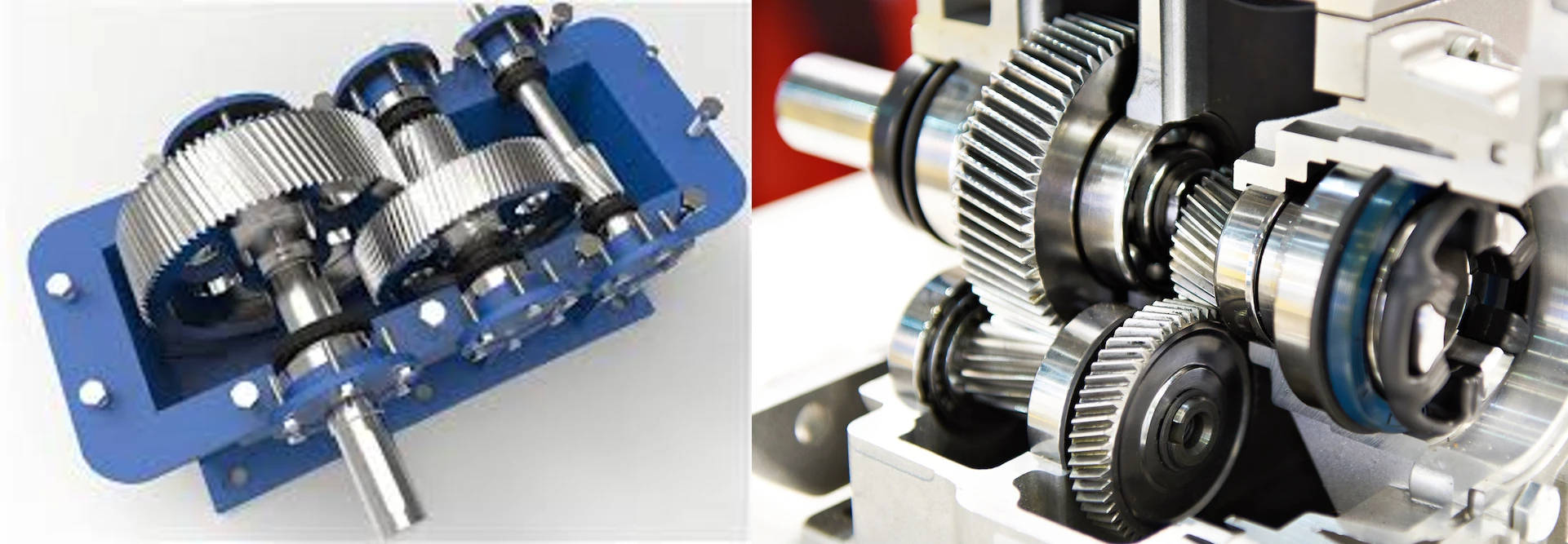
Tapered Roller Bearing Integration
To immunize the drivetrain against lateral displacement failure, engineers must rigidly specify Tapered Roller Bearings (TRB) or Angular Contact assemblies. The conical steel rollers within a TRB are mathematically angled to simultaneously absorb violent radial bending and severe axial pushing. Because industrial motors frequently brake and reverse direction (which instantly flips the thrust vector), these bearings are invariably mounted in opposed pairs. They are frequently arranged in a face-to-face (“X”) or back-to-back (“O”) configuration, firmly pre-loading the steel shaft to eliminate all end-play and backlash.
Overturning Bending Moments and Edge-Loading
Furthermore, the thrust force does not pull from the center of the shaft; it acts on the pitch line of the gear, which is radially offset. This creates a massive overturning bending moment ($M = F_a \times \text{pitch radius}$). This mechanical moment actively attempts to twist and bow the steel shaft within its rigid housing. If the lateral push force causes the shaft to bow even a fraction of a millimeter, the gear teeth lose parallel alignment. The high-pressure Hertzian contact patch violently shifts to the extreme outer corners of the teeth—a catastrophic failure mode known as “edge-loading,” which shears the tooth off at its root.
The Ultimate Physical Bypass: Internal Thrust Cancellation
While heavy tapered bearings successfully contain thrust in standard industrial machinery, there are extreme mechanical environments where the raw horsepower of the prime mover generates lateral forces so astronomically high that no commercially viable bearing assembly could survive. This scenario is common in multi-megawatt marine ship propulsion, massive mining ball mills, and steel rolling mill pinion stands. In these absolute extreme environments, metallurgical engineers refuse to fight the physics; instead, they cancel it internally.
This brilliant bypass is achieved by deploying a double helical gear architecture (commonly characterized as a herringbone gear). By CNC machining a left-hand helix and a perfectly symmetrical right-hand helix onto the exact same solid steel shaft blank, the gear still functions using inclined planes. However, because the two helix angles are exactly mirrored, they generate identical thrust vectors pointing in opposite directions.
These two opposing forces push violently directly toward the center of the solid gear blank, perfectly neutralizing each other out. This flawless kinematic self-cancellation results in a net external axial thrust of exactly zero. This allows transmission architects to utilize incredibly steep helix angles (often exceeding 35 degrees) for maximum strength and silence, while supporting the massive shaft purely on highly efficient, low-friction cylindrical radial bearings without placing any destructive strain on the gearbox casing.

Manufacturing Validation: Preventing Thrust Spikes at Korea Ever-Power
Calculating theoretical thrust vectors on a CAD blueprint is highly irrelevant if the physical transmission component is machined with inferior precision tolerances. If a CNC gear hobbing machine suffers from spindle runout, or if the steel warps irregularly during the high-temperature carburizing quench, the lead angle will contain microscopic deviations across the face width. Consequently, the axial thrust will not remain constant; it will violently pulse and fluctuate as the gears rotate, hammering the bearing cages with high-frequency shockwaves until they shatter.
Maintaining absolute kinematic stability requires world-class metrology and abrasive machining. As an elite South Korean helical gear manufacturer, Korea Ever-Power Worm Gear Co.,Ltd eradicates dynamic thrust spiking through uncompromising post-heat-treatment profile correction. Operating an ISO 9001 certified, climate-controlled facility equipped with heavy-duty German HÖFLER gear profile grinding equipment, we hold lead angle deviations to sub-micron DIN ISO 1328 Class 3 tolerances. By guaranteeing exact geometric consistency and programming deliberate parabolic lead crowning to compensate for shaft deflection, we ensure the calculated axial thrust remains perfectly smooth and predictable, safeguarding the fatigue life of your gearbox bearings in the most demanding heavy industrial applications across Korea, Japan, and Southeast Asia.
Extended Engineering FAQ
Why not utilize straight spur gears entirely to eliminate the bearing cost?
While straight spur gears generate zero thrust and operate on cheaper bearings, they lack the critical “overlap ratio.” This results in the violent, instantaneous collision of tooth flanks, generating severe high-frequency transmission error (acoustic whine) at high peripheral speeds. Additionally, their lack of multi-tooth load sharing means they possess roughly 30% less torque capacity than an angled equivalent. The cost of thrust bearings is the universally accepted penalty to achieve silent, high-density power transmission.
How do engineers use intermediate shafts to manage thrust in multi-stage gearboxes?
In multi-stage reduction gearboxes, an intermediate shaft carries both a driven gear and a driving pinion. Smart powertrain architects carefully select the “handedness” (Left-Hand vs. Right-Hand twist) of these two gears. By orienting them so that the axial thrust from the driven gear points in the opposite direction of the axial thrust from the driving pinion, the forces partially cancel each other out along the intermediate shaft. This strategy drastically reduces the net thrust load required by the intermediate bearings.
Can axial thrust cause lubrication failure in the gear mesh?
Thrust itself does not directly strip the lubrication film, but the resulting lateral shaft displacement absolutely can. If the thrust bearings are worn or improperly pre-loaded, the gear will slide laterally back and forth during operation. This sliding motion introduces a severe transverse friction component into the gear mesh, violently shearing the elastohydrodynamic (EHL) oil boundary layer. Once the oil film breaks down, microscopic metal-to-metal galling occurs immediately.
Do crossed-axis skew gears also generate lateral push?
Yes, absolutely. Because crossed helical gears transmit kinetic energy between non-parallel, intersecting 90-degree shafts via sliding point-contact, they generate significant lateral thrust along both the input and output shafts simultaneously. This extreme sliding friction is why crossed setups are limited to light instrument loads, whereas heavy right-angle torque requires a dedicated worm gear mechanism.
Why do double helical gears sometimes fail if they have “zero” net thrust?
While a perfectly machined double helical gear cancels thrust internally, catastrophic failure can occur due to apex misalignment. If the gearbox casing shifts, or if the transmission is heavily shocked, the torque may no longer be distributed perfectly 50/50 between the left and right halves. To prevent this destructive asymmetric loading, one of the two mating herringbone gears must be mounted on a “floating” shaft without restrictive axial bearings, allowing the kinetic forces to automatically self-center the gear.
What happens if bearing pre-load is specified incorrectly?
If the tapered bearings are installed with too much endplay (loose), reversing the motor will cause the axial thrust to violently slam the heavy steel shaft backward and forward, shattering the bearing cages via impact loading. Conversely, if the preload is too tight, the thermal expansion of the steel shaft as the gearbox heats to operating temperatures will brutally crush the conical rollers into the race, causing the bearings to friction-weld and seize within minutes.
Engineer Your Drivetrain for Ultimate Kinematic Stability
Do not permit uncontrolled lateral displacement vectors and inferior grinding tolerances to compromise your industrial gearbox. Partner with Korea Ever-Power for flawlessly executed power transmission components. From perfectly crowned single pinions to massive zero-thrust double assemblies, we deliver DIN-certified metallurgical excellence.
Editor: Cxm