Description
Plastic Helical Gear — Overview
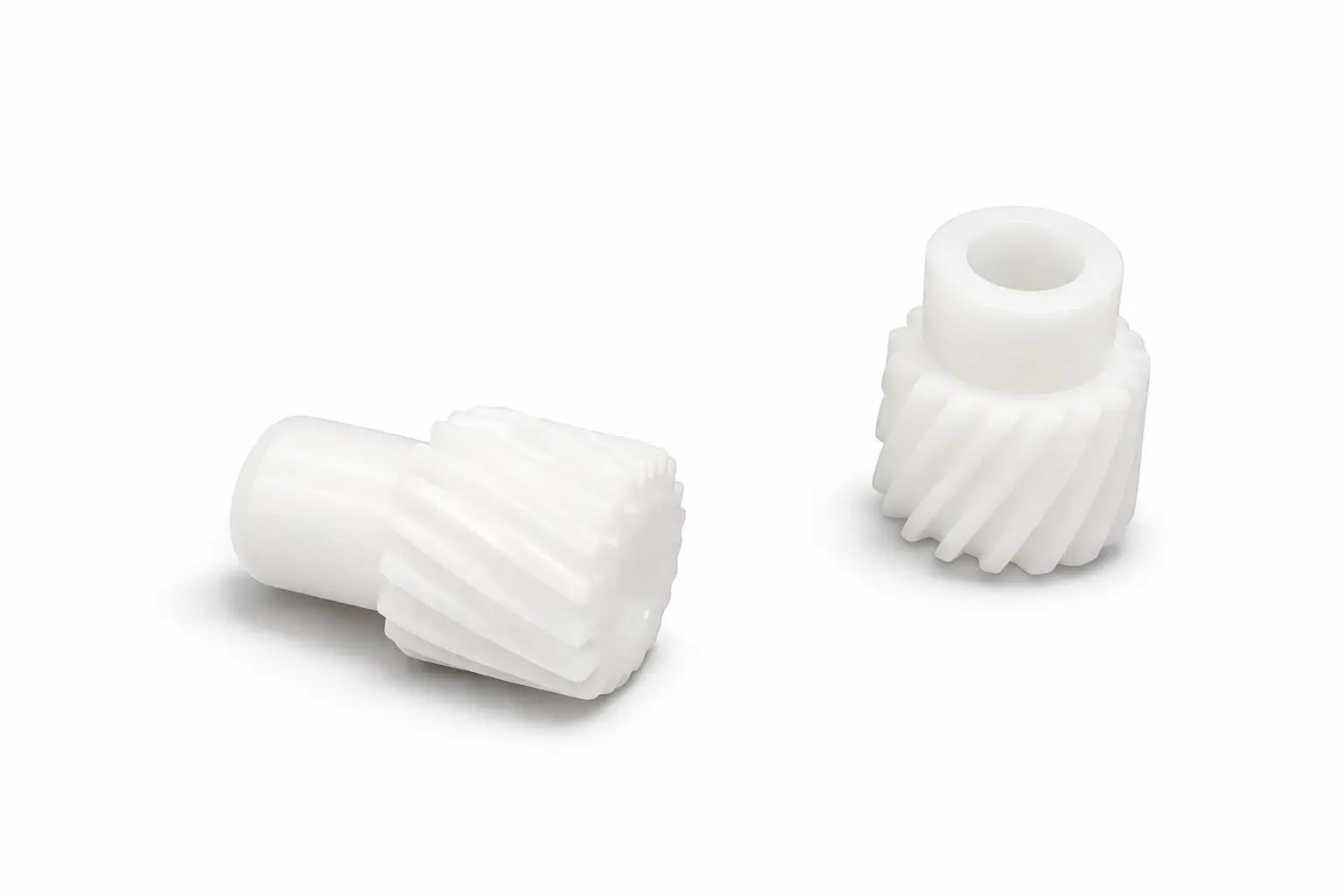
A plastic helical gear is a toothed wheel whose teeth are cut at a helix angle to the axis of rotation, machined or molded from engineering polymers rather than metal. Like metal helical cut gears, the angled tooth form produces gradual engagement from one edge of the tooth to the other as the gear rotates. This progressive contact reduces the impact load per tooth mesh and results in noticeably quieter operation compared with spur gears of the same pitch — a property that makes plastic helical gears the standard component in noise-sensitive consumer and commercial applications.

Korea Ever-Power Worm Gear Co.,Ltd supplies plastic helical gears in two primary materials: Polyacetal (POM, also known as Acetal or Delrin-equivalent) and Nylon (PA6/PA66). Both polymers offer inherent self-lubrication — the material itself reduces metal-on-plastic or plastic-on-plastic contact friction without requiring external grease or oil. The module range of M0.1 to M2.0 covers applications from watch mechanisms and miniature instrument drives up to light-duty speed reducers in appliances and vending machines. Custom bore sizes, D-hole configurations, keyway bores, and ODM specifications are available for OEM customers who need gears designed to their own part drawings.
Technical Specifications
The tables below give the general specification range for the plastic helical gear series and two specific reference configurations that can be ordered as standard items or used as the basis for custom modifications.
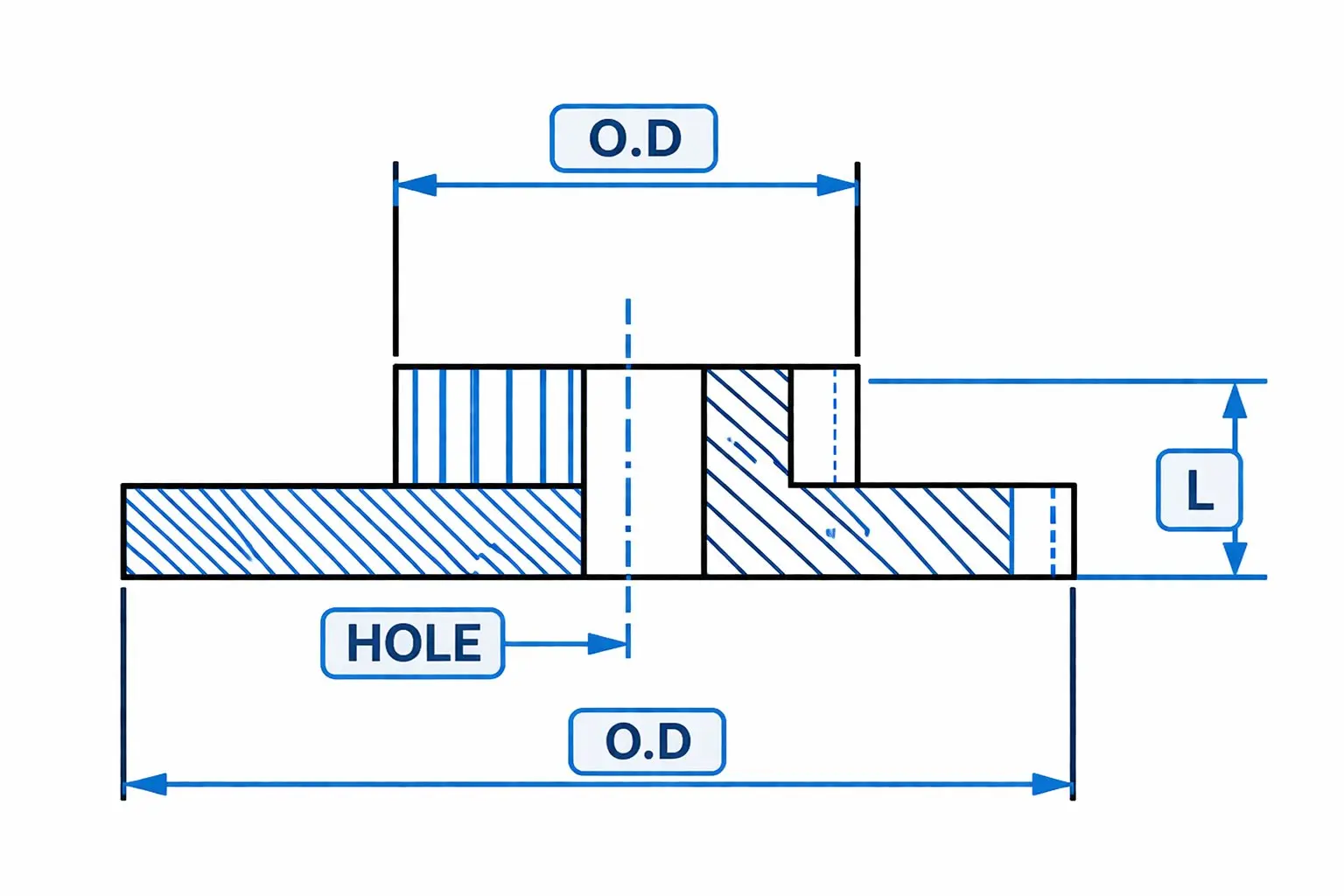
General Specifications
| Parameter | Specification |
|---|---|
| Type | Helical Gear |
| Module | M0.1 – M2.0 |
| Material | Polyacetal (POM) / Nylon |
| Bore | Ø1.40mm / Ø1.90mm / Ø2.05mm / Ø2.40mm / Ø2.55mm / Ø2.90mm / Ø3.05mm (Flexible) |
| Outer Diameter | Ø10.0mm – Ø50.0mm (Flexible) |
| Face Width (L) | 2.0mm – 10.0mm (Flexible) |
Reference Configuration A — D-Hole POM Helical Gear
| Parameter | Value |
|---|---|
| Item | D-Hole Helical Gear |
| Material | POM |
| Module | M0.6 |
| No. of Teeth | 16T |
| Weight | 0.95g / pcs |
| Application | Applies in any products with transmission design. |
Reference Configuration B — ODM Gear for IP Camera / Monitor
| Parameter | Value |
|---|---|
| Item | Gear |
| Material | ODM |
| Module | ODM |
| No. of Teeth | ODM |
| Weight | ODM |
| Application | IP Camera, monitor, etc. |
POM vs Nylon vs Metal — Choosing the Right Helical Gear Material
The choice between POM, Nylon, and steel for a helical gear is not simply about cost — each material has specific strengths and limitations that must match the operating environment. The comparison below covers the parameters that most often drive the material selection decision in light-duty transmission design.

| Property | POM (Polyacetal) | Nylon (PA6/PA66) | Carbon Steel (45#) |
|---|---|---|---|
| Density | 1.41 g/cm³ | 1.13–1.16 g/cm³ | 7.85 g/cm³ |
| Self-lubrication | Excellent — low friction coefficient vs steel | Good — absorbs minor moisture as lubricant | None — requires external lubrication |
| Corrosion resistance | High — not affected by most solvents or weak acids | Good — but absorbs moisture; dimensions may vary | Low — requires coating or sealed environment |
| Noise level (same load) | Very low — polymer absorbs vibration | Low | Higher — metal-to-metal impact resonance |
| Load capacity | Light to moderate duty | Light to moderate duty | Heavy duty — far higher tooth strength |
| Dimensional stability | High — low moisture absorption (0.2%) | Moderate — moisture absorption up to 3.5% affects bore size | High — stable across humidity range |
| Typical applications | Printers, cameras, medical devices, appliances | Conveyor components, food machinery, toys | Industrial gearboxes, heavy machinery drives |
For most precision light-duty applications — especially those requiring stable bore dimensions and good chemical resistance — POM is the first-choice material. Nylon is preferred where some impact absorption is beneficial and humidity is controlled. Where the transmitted load exceeds the capacity of either polymer, upgrading to a metal helical gear is the appropriate step, though the trade-offs in noise, weight, and lubrication requirement must then be managed.
Core Advantages of Plastic Helical Gears
◆ Inherent Self-Lubrication
POM and Nylon have low coefficients of friction against metal and against themselves. In most light-duty applications no external lubricant is needed for the gear mesh, reducing maintenance burden and eliminating the risk of lubricant contamination of adjacent components.
◆ Significant Weight Reduction
At 1.1–1.4 g/cm³ versus 7.85 g/cm³ for carbon steel, a POM or Nylon gear weighs roughly 80–85% less than a steel gear of identical dimensions. The D-hole M0.6 reference gear weighs 0.95g per piece — negligible in battery-powered or hand-held products where mass directly affects user experience.
◆ Chemical and Corrosion Resistance
POM resists most organic solvents, weak acids, and alkaline cleaning agents without surface degradation. This makes plastic helical gears suitable for environments where metal gears would corrode — food-contact equipment, laboratory instruments, and marine consumer electronics.
◆ Quiet Operation
The combination of helical tooth engagement and polymer damping gives plastic helical gears a notably lower noise profile than metal spur gears at comparable pitch-line velocities. In office equipment and domestic appliances, this difference directly affects product quality perception.
◆ Design Flexibility
Plastic gears can be injection-molded into complex hub geometries — D-holes, stepped bores, flanges, integrated bushings — that would require multiple machining operations in metal. This flexibility reduces the total part count in many gear train assemblies.
Industry Application Scenarios
Office Automation Equipment
Laser printers, multifunction copiers, scanners, and fax machines use dozens of small gear trains to drive paper feed rollers, toner cartridge mechanisms, and scanning heads. POM plastic helical gears are the default in these drives because they run quietly enough for shared office environments and require no lubrication that could migrate onto paper. The module range M0.5–M1.5 covers the majority of designs in this category.
Medical Devices and Diagnostic Equipment
Infusion pumps, laboratory analyzers, surgical robots, and diagnostic imaging equipment use compact helical gear trains in their drive mechanisms. The requirements are strict: no lubricant contamination of the sample path, minimal noise in clinical settings, and consistent dimensional performance across a temperature range of roughly 15°C to 40°C. POM gears satisfy these requirements and are compatible with standard medical-grade cleaning agents used for instrument disinfection.
Consumer Electronics and Security Cameras
Pan-tilt IP cameras, home security systems, digital camera autofocus mechanisms, and motorized window blinds all use miniature gear trains for their positioning drives. The ODM configuration in the specification table above was developed specifically for this category. The key requirements are consistent bore-to-tooth concentricity (to avoid hunting noise during pan-and-tilt sweeps) and resistance to the humidity and temperature swings typical of outdoor or semi-outdoor camera installations. POM’s low moisture absorption (0.2%) makes it preferable to Nylon in this use case.
Vending Machines and Small Appliances
Product dispensing mechanisms, coin-operated locks, and motor-driven carousel drives in vending machines operate in continuous-cycle duty with no routine maintenance. Nylon helical gears are preferred here because they tolerate occasional light shock loads from stuck or jammed products better than POM, and the slight moisture absorption in the vending environment acts as a low-level self-lubricant. Household appliance gear trains — mixers, blenders, and automatic coffee makers — follow a similar logic.
Custom Plastic Helical Gear Solutions
Korea Ever-Power provides handmade prototype and small-batch machined plastic helical gears before tooling investment is committed. This means a functional plastic gear can be tested in the actual product during the development stage, and any dimensional adjustments can be made before mold tooling is cut. This approach reduces the risk of expensive mold modifications after first article inspection.

- ➡ Module range: M0.1 to M2.0; custom modules available for OEM replacement specifications
- ➡ Bore options: Round bore, D-hole, keyed bore, step bore, flanged hub — specify on drawing
- ➡ Materials: Standard POM and Nylon PA6/PA66; glass-filled Nylon (GF30) for elevated load applications
- ➡ Prototype lead time: 7–14 days for machined prototypes (no tooling required)
- ➡ Production: Injection-molded production available after prototype sign-off; contact us for MOQ and tooling cost
Related Products
- ➜ Metal Helical Gears: For applications where load requirements exceed plastic capacity, see the full helical gear products range in alloy steel and carbon steel grades.
- ➜ Worm Gear: For compact right-angle reduction stages that feed a plastic helical output stage, a worm gear input provides a high ratio in a small envelope. Suitable for motorized window drives and appliance gearboxes.
- ➜ Double Helical Gear: Where plastic is insufficient and the load requires zero axial thrust, the double helical gear metal series handles heavy-duty industrial applications.

Frequently Asked Questions
What is the difference between POM and Nylon for plastic helical gears?
POM (Polyacetal) offers better dimensional stability because its moisture absorption is only about 0.2% — Nylon can absorb 2–3.5% moisture from the environment, which causes the bore diameter and tooth dimensions to change slightly with humidity. POM also has a lower and more consistent coefficient of friction against metal. Nylon is tougher under impact loads and is sometimes preferred in food-machinery drives where FDA-compliant material specifications are required.
What is the maximum torque a plastic helical gear can transmit?
POM and Nylon helical gears are rated for light-duty continuous torque. As an approximate guide, an M0.6 POM gear at 3,000 rpm continuous can handle around 0.01–0.02 Nm at the pitch cylinder before creep and tooth fatigue become risks over extended service. Exact limits depend on face width, ambient temperature, speed, and duty cycle. If your application approaches these limits, switching to a glass-filled Nylon (GF30) or a metal gear is the safer path.
Do plastic helical gears require lubrication?
In most light-duty applications, POM and Nylon gears do not need external lubrication — the polymer surface provides sufficient self-lubrication. However, if the gear runs against a metal pinion at elevated speed or load, applying a thin film of PTFE-dry lubricant or lightweight silicone grease to the tooth flanks will extend service life and reduce operating temperature. Petroleum-based greases should be avoided on POM as they can cause slight swelling over long exposure.
What is the operating temperature range for POM helical gears?
Standard POM maintains its mechanical properties from about -40°C to +90°C continuously. Short-term peaks up to 110°C are tolerable if the duty cycle allows cooling periods. Above 90°C continuous, the creep resistance of POM decreases and tooth deflection under load will exceed design assumptions. For applications above 90°C, glass-filled Nylon or metal gears should be specified.
Can you make a plastic helical gear to match an existing metal gear in the same gearbox?
Yes. Plastic-on-metal gear pairings are common and work well in light-duty drives. Running a POM or Nylon gear against a steel pinion can reduce overall mesh noise compared to metal-on-metal contact, while the steel pinion handles the higher tooth root stresses. Provide the metal gear’s module, pressure angle, number of teeth, and bore dimensions; Korea Ever-Power will produce a matching plastic gear to the same tooth form.
What types of helical gears does Korea Ever-Power manufacture?
The product range covers plastic helical gears (POM, Nylon), ground helical gears (15° and 19°31′), parallel axis helical gears, crossed helical (screw) gears, double helical gears, and internal helical ring gears. Material options span carbon steel, alloy steel, cast iron, stainless steel, and engineering polymers depending on the gear type.
How do I specify a custom plastic helical gear?
Provide the module, number of teeth, helix angle and hand (left or right), pressure angle (standard is 20°), bore type and diameter (round bore, D-hole, or other), face width, and material preference (POM or Nylon). If you have a sample gear or a drawing, send it directly — Korea Ever-Power will reverse-engineer if needed. For ODM projects with proprietary tooth forms, NDA signing is available before technical discussions begin.
How long do plastic helical gears last in a printer or scanner drive?
Service life depends on speed, load, duty cycle, and ambient temperature. In a typical laser printer paper-feed drive running at 1,000–3,000 rpm, POM gears routinely exceed 500,000 to 1,000,000 cycles before showing measurable tooth wear — equivalent to several years of daily use in an office environment. Abnormal wear occurs when the gear runs dry at elevated temperature or when the bore fit is too tight and introduces concentrated radial load at the tooth root.
Customer Reviews
Kim Soo-yeon, Product Engineer, Seoul Printer Components (Q3 2024)
“We source M0.6 D-hole POM helical gears from Ever-Power for our paper feed assembly. The bore tolerance on the D-hole is consistent lot to lot — no adjustment needed at assembly. Gear noise in our finished product is within spec. We have been reordering every quarter for about eighteen months.”
Bae Jae-hyun, Design Engineer, Suwon Medical Device Lab (Q4 2024)
“For a syringe pump prototype we needed a small POM helical gear train that could withstand autoclave cleaning cycles — we specified POM for its chemical resistance and dimensional stability. Ever-Power machined prototypes in two weeks, which was fast enough for our development timeline. Dimensions were accurate on all four prototype pieces.”
Ahmad Rizal, Mechanical Designer, Penang Electronics OEM (Q2 2024)
“We needed ODM plastic helical gears for a pan-tilt security camera module. Sent a drawing and got a prototype back in eleven days. The fit was exactly right — the gear ran without hunting noise through the full pan range. We are now in low-volume production with them. Good technical communication; they pointed out that our specified bore tolerance was slightly over-tight and suggested a change that reduced our scrap rate.”
Choi Eun-ji, Purchasing Manager, Busan Home Appliance Parts (Q1 2025)
“Switched from a domestic Nylon gear supplier to Ever-Power POM after experiencing dimensional drift issues in humid summer months. The POM gears show no measurable change in bore diameter across seasons. Assembly rejection rate dropped from about 4% to under 0.5% in the first production run. Price is comparable to what we paid before.”
Nguyen Thi Lan, R&D Engineer, Ho Chi Minh City Consumer Electronics (Q3 2024)
“We ordered Nylon helical gears for a vending machine dispenser mechanism. The gears handle the occasional shock load when product gets stuck without cracking — we tried POM first and had some brittle failures at the tooth root under shock. The switch to Nylon fixed that. Ever-Power advised this based on our description of the loading pattern before we placed the order.”