Why Viscosity Governs EHL Film Thickness
The EHL film at the helical gear tooth contact zone is generated by the hydrodynamic wedge effect as the two tooth surfaces converge at the approach side of the mesh. The film thickness h_min is governed by the Dowson-Higginson formula (line contact, simplified):
h_min ∝ (η₀ × v_Σ)^0.7 × R’^0.46 / (E’^0.03 × w’^0.13)
where: η₀ = dynamic viscosity at inlet temperature [Pa·s]
v_Σ = sum velocity = v₁ + v₂ ≈ 2 × v_t (rolling velocity sum) [m/s]
R’ = equivalent radius of curvature at contact [mm]
E’ = equivalent elastic modulus ≈ 226,000 N/mm² (steel-steel)
w’ = normal load per unit contact length [N/mm]
Key relationship: h_min ∝ η₀^0.7 and h_min ∝ v_t^0.7
Doubling oil viscosity (at the same temperature): h_min increases by 2^0.7 = 1.62×
Doubling pitch-line velocity (same viscosity): h_min increases by 2^0.7 = 1.62×
→ Both levers have the same 0.7 power — viscosity and speed are equally effective
at increasing the EHL film. However, speed is set by the application; viscosity
is the design variable the engineer controls.
For a helical gear, the film ratio λ = h_min / R_q must reach ≥ 2.0 for full EHL protection. For a precision ground helical gear (Ra ≈ 0.2 µm) (R_q ≈ 0.25 µm per flank), the composite R_q ≈ √(0.25² + 0.25²) = 0.35 µm, requiring h_min ≥ 0.70 µm for λ = 2.0. The viscosity grade is selected to achieve this film at the actual mesh zone temperature during normal operation.
Viscosity-Temperature Relationship — Why Operating Temperature Matters
ISO VG grades are defined at 40°C. The helical gear mesh zone typically operates at 60–80°C (mesh zone bulk temperature), and the oil viscosity at this temperature is substantially lower than the nominal VG grade suggests. The viscosity at operating temperature must be calculated using the viscosity-temperature model (ASTM D341 or Walther equation):
Kinematic viscosity ratio (Walther equation, simplified):
log log(ν + 0.7) = A − B × log(T_abs)
where ν = kinematic viscosity [mm²/s = cSt], T_abs = temperature [K]
Constants A, B are fitted to the oil’s viscosity at two known temperatures.
Approximate viscosity at operating temperature for mineral oil (VI ≈ 100):
ISO VG 68 at 40°C → approx. 15 cSt at 80°C
ISO VG 100 at 40°C → approx. 20 cSt at 80°C
ISO VG 150 at 40°C → approx. 28 cSt at 80°C
ISO VG 220 at 40°C → approx. 38 cSt at 80°C
ISO VG 320 at 40°C → approx. 52 cSt at 80°C
ISO VG 460 at 40°C → approx. 70 cSt at 80°C
ISO VG 680 at 40°C → approx. 98 cSt at 80°C
PAO synthetic (VI ≈ 150) retains approximately 30–40% higher viscosity at 80°C
than mineral oil of the same ISO VG grade at 40°C — a significant advantage.
ISO VG Grade Selection — Pitch-Line Velocity and Temperature Table
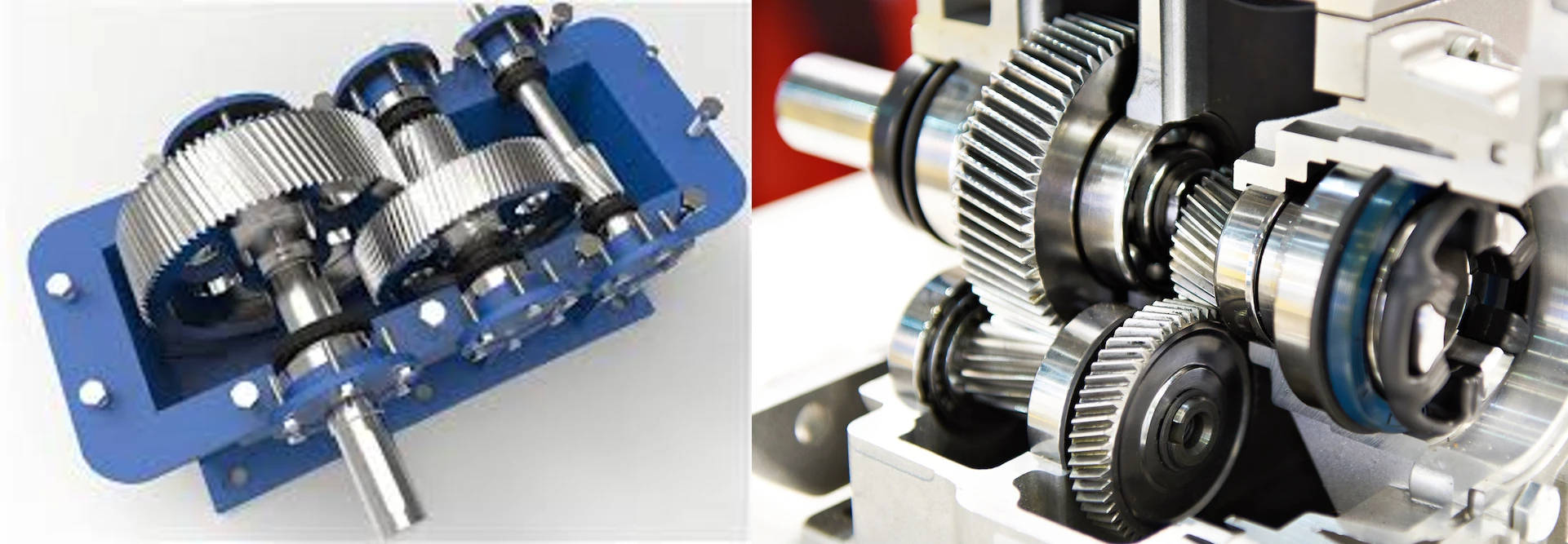
Helical gear gearbox with oil bath sump — the correct ISO VG grade must provide sufficient viscosity at the mesh zone operating temperature (typically 60–80°C for industrial gearboxes) to achieve λ ≥ 2.0, while remaining low enough at the minimum ambient start temperature to flow through the filter and reach the mesh within the first 30–60 seconds of operation
The following table provides ISO VG grade recommendations for carburized and ground helical gears (tooth surface Ra ≤ 0.3 µm) at oil sump temperature 60–80°C, based on AGMA 9005-F16 Table 2 (industrial enclosed gear drives):
| Pitch-Line Velocity v_t | Recommended ISO VG (Mineral CLP) | Recommended ISO VG (PAO CLP HC) | Remarks |
|---|---|---|---|
| < 0.5 m/s (very slow) | VG 680–1000 | VG 460–680 | Boundary lubrication regime; high viscosity compensates for lack of hydrodynamic film. Applicable to rubber mixer and plate mill gears (Art64, Art68). |
| 0.5–5 m/s (slow to moderate) | VG 320–680 | VG 220–320 | Mixed lubrication to early EHL. Agricultural gearboxes (Art56), crane hoists (Art70), general industrial M10+ gears. |
| 5–15 m/s (industrial standard) | VG 150–320 | VG 100–220 | Full EHL at the higher end of this range. Most enclosed industrial helical gear gearboxes fall in this category. |
| 15–25 m/s (fast) | VG 68–150 | VG 68–100 | Full EHL readily achieved; churning loss rises steeply above VG 220 at these speeds. Compressor gearboxes (Art50), large industrial fan drives (Art69). |
| > 25 m/s (high speed) | VG 32–100 (mineral marginal) | VG 32–75 PAO preferred | At >40 m/s, PAO is strongly preferred — lower traction coefficient and better viscosity index maintain film quality. EV reducers (Art62), turbine speed increasers (Art69). |
ISO 6743-6 Gear Lubricant Categories — Which Type for Helical Gears?
ISO 6743-6 classifies gear lubricants by their base oil and additive type. Selecting the correct category is as important as selecting the correct ISO VG grade — the wrong category with the correct viscosity still protects inadequately:
Standard mineral base oil with sulphur-phosphorus (S/P) extreme pressure additive. Correct for most industrial helical gear drives at v_t = 1–20 m/s. FVA micropitting rating MLS 6–8. Change interval: 3,000–8,000 hours depending on condition monitoring. Most cost-effective choice for standard gearboxes.
Hydrocracked Group III base oil with improved oxidation stability and slightly higher VI (≈ 120) than conventional CLP. 20–30% longer service life than CLP. Recommended for helical gear gearboxes in higher ambient temperature or extended-interval service. FVA micropitting rating MLS 8–10. Better option for wind turbine main gearboxes and offshore gearboxes.
PAO Group IV synthetic base oil; VI ≈ 150. Best high-speed performance (lower traction coefficient → higher efficiency), best cold-temperature flow, longest service life (5,000–12,000 hours). Preferred for EV reducers, BFP helical drives, and any helical gear application where energy efficiency is monetised. Approximately 2–3× more expensive per litre than CLP mineral.
NOT recommended for standard helical gears. Polyglycol base oil is excellent for worm gears (very low traction coefficient on bronze-steel contacts) but attacks nitrile rubber seals and emulsifies with water more readily than PAO. The few exceptions are special applications with worm-helical gear compound gearboxes where the worm stage takes priority, or stainless-shaft drives where nitrile seals are not used.
Mineral vs PAO — When Does the Upgrade Pay Off?
Upgrading from CLP mineral to CLP PAO for a helical gear drive yields three paybacks: efficiency (reduced churning and mesh friction → lower energy cost), longer oil service life (reduced maintenance interval and downtime), and better protection at extreme temperatures. Whether the upgrade pays off depends on the operating profile:
Efficiency payback calculation (example: 75 kW helical gear drive, CLP 220 → PAO 220):
Efficiency improvement: approximately 0.5–1.0% (mesh + churning loss reduction)
Annual energy saving: 75 kW × 0.007 × 8,000 h/year = 4,200 kWh/year
At USD 0.12/kWh: USD 504/year energy saving per drive
Oil service life payback:
CLP 220 mineral: oil change every 3,000 hours → 2.7 changes/year for 8,000 h/year
CLP PAO 220: oil change every 8,000 hours → 1 change/year
Annual oil volume saving: 1.7 changes × oil volume = significant for large gearboxes
Break-even: PAO typically costs 2–3× CLP mineral per litre. For a 100-litre gearbox:
PAO premium per fill: USD 300; energy saving: USD 504/year → payback < 1 year.
For drives operating <2,000 hours/year or with small oil volume, CLP mineral is more cost-effective.
Cold-Start Viscosity — Minimum Ambient Temperature Requirement
A helical gear gearbox must never be started at full load before the oil has flowed from the sump to the gear mesh and bearing positions. At very low ambient temperatures, high-viscosity mineral oil can gel or flow so slowly that the first 30–60 seconds of operation run without adequate lubrication. The minimum ambient temperature for full-load start without pre-heating:
Mineral CLP gear oil pour point and minimum start temperatures (approximate):
VG 220 CLP mineral: pour point ≈ −15°C; minimum full-load start ≈ −5°C
VG 320 CLP mineral: pour point ≈ −12°C; minimum full-load start ≈ 0°C
VG 680 CLP mineral: pour point ≈ −9°C; minimum full-load start ≈ +5°C
VG 220 PAO: pour point ≈ −45°C; minimum full-load start ≈ −30°C
VG 320 PAO: pour point ≈ −42°C; minimum full-load start ≈ −25°C
For gearboxes in cold climates (Korean winter, Siberian installations, Arctic offshore):
PAO synthetic is often the only viscosity-grade option that avoids oil heater requirements.
Korea Ever-Power — Oil Viscosity Recommendation with Gear Orders

Korea Ever-Power’s measured tooth surface Ra from the production gear (Ra ≤ 0.2 µm for DIN Class 5, Ra ≤ 0.4 µm for DIN Class 7) is used to calculate the composite R_q and the required h_min for λ = 2.0 — which directly determines the minimum ISO VG grade needed at the specified operating temperature for the helical gear installation
Korea Ever-Power provides the recommended ISO VG grade (and the minimum λ = h_min/R_q calculation that justifies it) with every helical cut gear order — using the actual measured tooth surface Ra from the production gear, not a class-assumed value. The oil recommendation includes the minimum ambient start temperature for the specified grade, and flags if PAO synthetic is needed for cold-climate operation. As a direct helical gear manufacturer, Korea Ever-Power cross-checks the oil viscosity recommendation against the gear’s pitch-line velocity and the churning loss calculation — recommending a lower viscosity grade if the customer has specified an unnecessarily high VG that would reduce efficiency without improving the λ ratio. Browse the helical gear product range.
Frequently Asked Questions
Not necessarily. If the motor is replaced to run faster (higher pitch-line velocity), the existing high-viscosity oil may cause excessive churning loss and high oil temperature. If the motor is replaced to run slower, the original viscosity may be too low for adequate EHL film at the reduced pitch-line velocity. When the speed of an existing helical gear gearbox changes by more than ±30%, the oil viscosity grade should be recalculated at the new operating speed to confirm λ remains above 2.0. Korea Ever-Power provides this recalculation for any helical gear drive that has undergone a speed change — the calculation takes the actual gear geometry (module, face width, pitch diameter) and the new speed as inputs.
In a shared-sump helical gear gearbox (the most common arrangement), all stages share the same oil — compromising between the ideal viscosity for the high-speed first stage (lower VG) and the ideal for the low-speed final stage (higher VG). The standard approach is to select the oil viscosity for the most critical stage (typically the highest-pitch-line-velocity stage, where churning loss is most sensitive to viscosity) and accept a slightly sub-optimal λ at the slower stages — which are typically not critical because their lower pitch-line velocity means the EHL film is already thick. For gearboxes where the speed ratio between the first and final stage exceeds 10:1 (v_t ratio exceeds 10:1), separate oil chambers for each stage — each with its own optimised oil grade — are worth considering to avoid both over-lubrication at the high-speed stage and under-lubrication at the low-speed stage.
Yes, indirectly — through two mechanisms. A larger-module helical gear has a larger equivalent contact radius R’, which increases h_min at the same viscosity and speed (h_min ∝ R’^0.46). This means large-module helical gears can achieve the same λ = 2.0 target with a lower viscosity than small-module gears at the same pitch-line velocity. However, large-module gears often run at lower pitch-line velocities — partially offsetting this advantage. The net effect: for very large module gears (M20+) running at slow speeds (0.5–3 m/s), the combination of large R’ and low speed makes the EHL film formation marginal even with very high viscosity oils — which is why EP boundary lubrication becomes critical for large-module helical gears.
Polyglycol oils are incompatible with NBR seals used in virtually all industrial helical gear gearboxes. CLP PG oil swells and degrades NBR seals within weeks of exposure, causing oil leaks that contaminate the environment and lead to oil starvation of the gear drive. A second concern is water emulsification: CLP PG absorbs water and forms a stable emulsion that is difficult to remove by water separation — the emulsified water then causes rust inside the gearbox housing and on the tooth flanks of the helical gear. CLP PG is the correct lubricant for worm gearboxes (where the low traction coefficient of PG on bronze is uniquely beneficial) — but for any drive with a helical gear stage, CLP PAO is the high-performance synthetic of choice, not CLP PG.
ISO VG Grade Recommendation with Every Helical Gear Order
Korea Ever-Power calculates λ = h_min / R_q at the measured Ra and actual pitch-line velocity, then recommends the minimum ISO VG grade and oil category (CLP / CLP HC / CLP PAO) — with minimum start temperature and oil service interval — as standard in the order documentation. No separate lubricant engineering required.
λ = h_min / R_q calculation · ISO VG grade selection · CLP / CLP HC / CLP PAO recommendation · Cold-start temperature · Service interval · Standard inclusion
Editor: Cxm