Tvrdozubený špirálový prevod s bokom vysokorýchlostnej lokomotívy – DIN trieda 6 pre trakčné pohony

Korea Ever-Power supplies this hard tooth flank helical gear in 17CrNiMo6 — the standard European case-hardening alloy for railway traction gearboxes. Reference configuration: Mn=4, Z=132, β=18°, pressure angle 20°, DIN 3962 class 6. Manufacturing sequence: forging → lathing → hobbing → carburizing → external grinding → tooth grinding. Carburized case to HRC 58–62, tooth flank Ra 0.6 after grinding. Pitch diameter 528mm. Designed for high-speed locomotive traction gearboxes, EMU wheel drives, and urban rail traction systems where transmission accuracy, NVH performance, and operational safety certification are the primary design requirements.
High Speed Train Locomotive Hard Tooth Flank Helical Gear — Overview
The traction gearbox of a high-speed railway vehicle faces engineering demands that no other rotating machinery category matches: pitchline velocities of 50–120 m/s, sustained full-load operation for hours at a stretch across millions of kilometres, vibration and noise constraints that directly affect passenger comfort scores, and safety certification requirements that mandate full material and process traceability on every gear. The high speed train hard tooth flank špirálové ozubené koleso from Korea Ever-Power Worm Gear Co.,Ltd is manufactured specifically for this duty, using 17CrNiMo6 alloy steel — the EN 10084 grade specified by European and Korean high-speed rail equipment manufacturers — through a complete forging, carburizing, and tooth-grinding sequence to DIN 3962 class 6 accuracy.
The reference configuration — Mn=4, Z=132, helix angle β=18°, pressure angle 20° — gives a pitch diameter of 528mm. This places it in the size range of a high-speed locomotive wheel gearbox primary gear or an EMU bogie gear, where the gear must transfer motor power to the axle at reduction ratios of 3:1 to 6:1 while running continuously at wheel speeds corresponding to 200–350 km/h line speed. The 18° helix angle is a deliberate choice for railway traction: large enough to provide significant overlap contact ratio improvement over spur gears (which are never used in traction gearboxes), but moderate enough that axial thrust loads remain manageable with the angular-contact bearings standard in railway axlebox assemblies. Korea Ever-Power's hard tooth flank helical gear production for railway applications includes full material traceability, dimensional inspection reports, and magnetic particle inspection certificates — all required for railway qualification programs.
Technické špecifikácie
Gear Basic Data — Reference Configuration
| Parameter | Hodnota |
|---|---|
| Gear Tooth Shape | Involute |
| Materiál ozubeného kolesa | 17CrNiMo6 (EN 10084; carburized and quenched, HRC 58–62 case) |
| Gear Process | Forging → Lathing → Hobbing → Carburizing → External Grinding → Tooth Grinding |
| Uhol tlaku | 20° |
| Quality Level | DIN 3962 Trieda 6 |
| Typ prevodového stupňa | Mn=4, Z=132, β=18°, α=20° |
| Calculated Pitch Diameter | 528 mm (Mn × Z) |
Manufacturing Capabilities — Internal Gears and Internal Splines
| MILLING | SHAPING | TOOTH GRINDING | |
|---|---|---|---|
| Maximum O.D. | 2500 mm | 2500 mm | 2500 mm |
| Minimum I.D. | 650 mm | 50 mm | 100 mm |
| Maximum Face Width | 500 mm | 500 mm | 500 mm |
| Maximum Module | 26 mm | 26 mm | 45 mm |
| AGMA / DIN Level | Trieda DIN 8 | Trieda DIN 8 | Trieda DIN 4 |
| Tooth Surface Finishing | Relatívna citlivosť 3,2 | Relatívna citlivosť 3,2 | Relatívna citlivosť (Ra) 0,6 |
| Maximum Helix Angle | ±22,5° | ±22,5° | ±45° |
Manufacturing Capabilities — External Gears and External Splines
| HOBBING | MILLING | TOOTH GRINDING | |
|---|---|---|---|
| Maximum O.D. | 1250 mm | 2500 mm | 2500 mm |
| Minimum O.D. | 20 mm | 200 mm | 20 mm |
| Maximum Face Width | 500 mm | 500 mm | 1480 mm |
| Maximum Module | 26 mm | 26 mm | 45 mm |
| AGMA / DIN Level | Trieda DIN 8 | Trieda DIN 8 | Trieda DIN 4 |
| Tooth Surface Finishing | Relatívna citlivosť 3,2 | Relatívna citlivosť 3,2 | Relatívna citlivosť (Ra) 0,6 |
| Maximum Helix Angle | ±45° | ±45° | ±45° |
Why 17CrNiMo6 Is the Railway Standard for Traction Gear Steel
17CrNiMo6 (EN 10084) is a nickel-chromium-molybdenum case-hardening alloy used almost universally in European and Korean high-speed rail traction gearboxes. Its composition gives three properties that alternative materials cannot match simultaneously:

- ◈ Deep hardenability: Chromium (1.50–1.80%) and molybdenum (0.25–0.35%) together ensure that the carburized case transforms to martensite uniformly across the entire tooth flank surface of a 528mm pitch-diameter gear during quench — no soft spots in the case that would create localized pitting under the high contact stresses of traction service.
- ◈ Sub-zero toughness: Nickel content (1.40–1.70%) maintains fracture toughness down to approximately -40°C. Railway traction gearboxes are exposed to outdoor temperature extremes — trains running in Korean winter conditions at temperatures below -20°C require gear materials that do not become brittle at the tooth root under the shock loads from rail joints and switches.
- ◈ Thermal fatigue resistance: Molybdenum addition stabilizes the tempered martensite structure against softening during repeated thermal cycling from traction motor braking loads. This property is critical in traction gears that experience rapid load reversals during regenerative braking sequences at high speed.
Hard Tooth Flank vs Soft Tooth Flank — Railway Traction Gear Comparison

In railway traction gearboxes, the choice between hard tooth flank (carburized) and soft tooth flank (normalized or quenched-and-tempered) gears is not a cost trade-off — it is a service-life and safety requirement. The following comparison explains why hard tooth flank helical gears are mandatory for main traction duties in high-speed rail.
| Parameter | Soft Tooth Flank (HB 220–280) | Hard Tooth Flank (HRC 58–62) |
|---|---|---|
| Allowable contact stress (Hertzian) | ~900–1000 MPa | ~1500–1650 MPa — mandatory for high-speed traction loads |
| Service life at traction load cycles | 2–4 years between overhauls | 8–15 years — matches typical railway maintenance intervals |
| NVH at high pitch-line velocity | Higher transmission error → elevated cabin noise | Ground hard case → lower Ra → lower transmission error → quieter |
| Low-temperature toughness | Adequate for 45# QT; limited by material grade | 17CrNiMo6 core: tough to -40°C by design |
| Railway qualification feasibility | Not accepted by railway certification standards for main traction duty | Specified by EN 15313, IEC 61800 and equivalent railway OEM standards |
DIN Class 6 Precision and NVH for Passenger Rail

In passenger rail, gear noise affects passenger satisfaction scores and, in many countries, regulatory compliance with interior noise level requirements. The traction gearbox contributes a measurable fraction of total car interior noise at line speed — even after bogie and floor transmission paths are accounted for. DIN 3962 class 6 defines tight tolerance bands on tooth profile deviation, lead deviation, pitch accumulation, and total radial composite error. At this accuracy level, the transmission error excitation at the mesh frequency is suppressed to a point where gear mesh harmonic tones are typically 10–15 dB below the floor of the overall car interior noise spectrum at 300 km/h. Achieving DIN class 6 on a 528mm pitch diameter gear in carburized 17CrNiMo6 requires tooth grinding after heat treatment using a machine capable of maintaining the required positional accuracy on a large, heavy workpiece — Korea Ever-Power's German HÖFLER grinding machines are specified for exactly this type of precision large-gear production.
The Ra 0.6 tooth flank surface produced by finish grinding serves two functions beyond noise reduction: it maintains a stable lubricant film at high pitch-line velocities (EHL film theory requires a smooth surface to prevent breakdown at the asperity scale) and it produces the residual compressive stress pattern at the tooth surface that extends contact fatigue life. A hobbed surface at Ra 3.2 on the same gear body would see significantly higher contact stress concentration at surface asperities and substantially shorter pitting-free operating life.
Core Performance Advantages for Railway Traction Applications

◈ Extended Traction Service Life
HRC 58–62 carburized 17CrNiMo6 supports the contact fatigue strength required for 8–15 year intervals between traction gearbox overhauls — matching the scheduled maintenance cycles of Korean KTX and equivalent high-speed rail fleets.
◈ Low Transmission Error at Speed
DIN class 6 tooth accuracy combined with Ra 0.6 tooth flank suppresses gear mesh harmonic excitation at pitch-line velocities up to 120 m/s — the operating range of 300+ km/h high-speed rail vehicles.
◈ Cold-Climate Operational Reliability
17CrNiMo6's nickel content maintains fracture toughness at -40°C — essential for railway vehicles operating in Korean winter conditions or export to cold-climate markets in Northern Europe and Northeast Asia where brittle fracture risk is a design concern.
◈ Per-Gear Traceability Code
Each gear carries a permanent traceability mark linking it to its forging batch, carburizing furnace number, raw material certificate, and gear measuring center inspection report — meeting the documentation requirements of railway OEM qualification programs and maintenance audit trails.
◈ MPI-Verified Grinding Quality
100% fluorescent magnetic particle inspection on all ground tooth surfaces detects grinding cracks that are invisible to the naked eye. No gear with a surface indication leaves Korea Ever-Power's facility, removing the most common quality failure mode from the supply chain.
Application Scenarios in Railway Traction Systems

High-Speed Locomotive Traction Gearbox
In a high-speed locomotive, each powered axle is driven by a traction motor through a single-stage or double-stage helical reduction gearbox mounted on the bogie frame. The primary gear in this arrangement takes the full motor output torque — typically 10,000–30,000 Nm per bogie depending on the locomotive class — and transmits it to the wheel axle at a speed ratio of 4:1 to 6:1. Pitch-line velocities in this service reach 80–120 m/s at 300+ km/h line speed. The Mn=4, Z=132, β=18° reference gear provides both the contact fatigue resistance and the low transmission error performance that this duty requires. For rail operators sourcing ozubené koleso so špirálovým rezom replacement components, Korea Ever-Power's reverse engineering service accepts worn gears from scheduled overhauls as the basis for a matched replacement order.
Electric Multiple Unit (EMU) Wheel Drive Gearboxes
EMU traction systems distribute power across multiple axles on a train set, with each motorized axle carrying a bogie-suspended gearbox. The gearbox in this configuration must accommodate bogie rotation relative to the train body (typically ±5°) through a flexible coupling, while the gear mesh itself operates under continuous cyclic loading from traction and braking. The 18° helix angle balances axial force against contact ratio: lower helix angles would reduce NVH performance; higher angles would generate axial forces that complicate the flexible coupling design. At β=18°, the resulting axial force is approximately 33% of the tangential force — a manageable level for the angular-contact bearings standard in EMU bogie gearbox construction. For technical consultation on špirálové ozubené koleso selection for rail traction applications, contact Korea Ever-Power through the výrobca špirálových ozubených kolies domovská stránka.
Urban Metro and Light Rail Traction Drives
Metro and LRT vehicles operate at lower maximum speeds than intercity HSR — typically 80–140 km/h — but experience more frequent acceleration and braking cycles than long-distance trains. The cumulative number of load cycles over a 30-year vehicle life is comparable to or exceeds that of a high-speed locomotive. Hard tooth flank gears in 17CrNiMo6 provide the fatigue life required for this long-cycle-count duty. The compact bogie design of metro vehicles also demands tight gear geometry — a DIN class 6 ground gear achieves the contact pattern quality that allows designers to operate at the tooth module and face width limits needed to fit within the bogie frame envelope.
Traceability, Documentation, and Quality System

Railway gear qualification programs require documentation depth that exceeds what is standard in general industrial supply chains. Korea Ever-Power's standard documentation package for railway traction gears includes:
- ✔ Raw material certificate: EN 10084 17CrNiMo6 mill heat number, full chemical analysis, mechanical property test results (yield strength, tensile strength, Charpy impact at -40°C), material identification linked to gear traceability code.
- ✔ Forging documentation: Forging press record, normalizing heat cycle parameters, ultrasonic testing result for internal discontinuities.
- ✔ Heat treatment record: Carburizing atmosphere cycle, quench date and temperature, tempering parameters, case depth measurement (per EN ISO 6508), case and core hardness per sampling plan.
- ✔ Gear measuring center report: Profile deviation, lead deviation, pitch accumulation, runout — all per DIN 3962 class 6 tolerance bands, measured by gear analyzer and reported numerically.
- ✔ Magnetic particle inspection certificate: 100% fluorescent MPI on all ground surfaces, operator identification, no-indication confirmation.
- ✔ Permanent traceability marking: Each gear bears a unique ID code linking all of the above records for lifetime maintenance audit purposes.
Typy výstroja z Kórey Ever-Power

Beyond railway traction gears, Korea Ever-Power manufactures a full range of gear types for industrial and transportation drive systems. If your application requires a different gear configuration or complementary components, the following are all within our manufacturing capability:
- ⬡ Čelné ozubené koleso: For lower-speed auxiliary drives on railway vehicles and rolling stock maintenance equipment where noise performance is less critical than in traction service.
- ⬡ Kužeľové ozubené koleso: Right-angle drives for ancillary systems — compressor drives, alternator drives, and bogie yaw damper mechanisms where shaft axes are non-parallel.
- ⬡ Šnekový prevod: Compact high-ratio drives for HVAC damper actuators and sliding door mechanisms on rail vehicles. The závitovkový prevod series covers the required reduction ratios with self-locking options.
- ⬡ Double Helical Gear: For high-power parallel-shaft industrial drives where eliminating axial thrust reduces bearing complexity. See the dvojité špirálové ozubené koleso series for specifications.
- ⬡ Vnútorný ozubený veniec: For epicyclic gearboxes and planetary reduction stages used in compact traction motor drives and rail vehicle auxiliary power units.
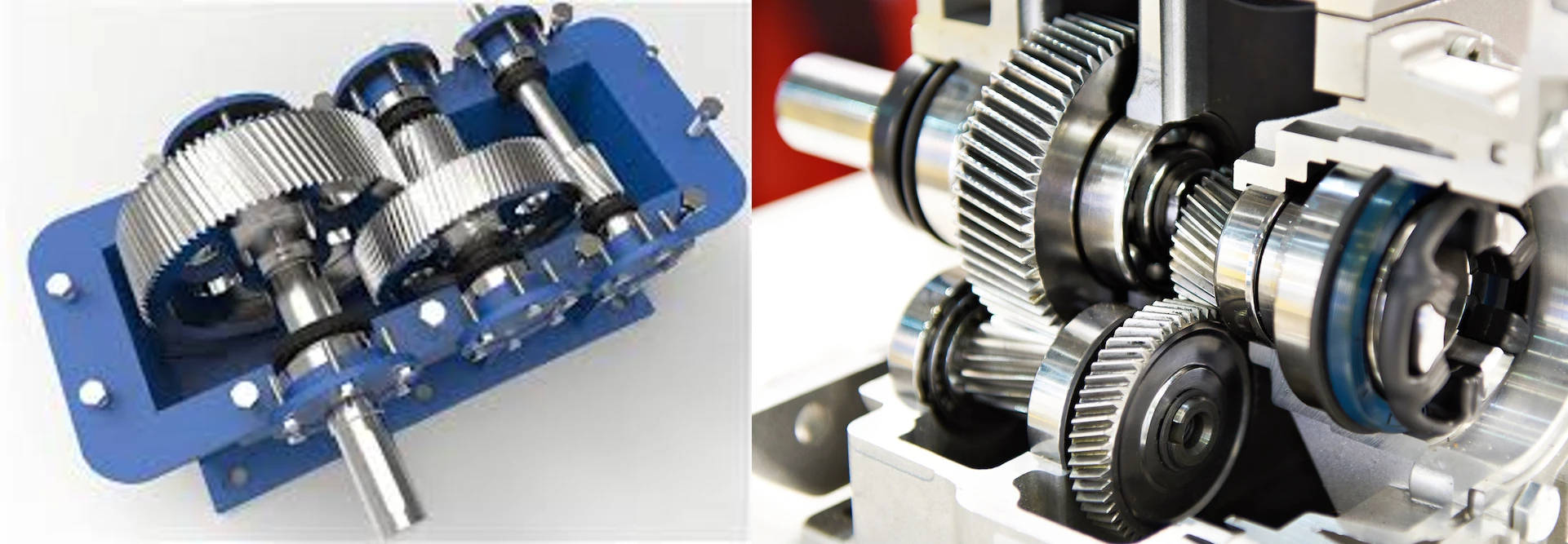
For railway maintenance workshops and industrial users requiring a complete enclosed drive rather than loose gears, assembled špirálová prevodovka reducer units are available. Contact Korea Ever-Power with your application details — vehicle type, motor torque, gear ratio, operating speed, and documentation requirements — for a technical proposal.
Často kladené otázky
What is the difference between 17CrNiMo6 and 18CrNiMo6 for traction gear applications?
Both are nickel-chromium-molybdenum case-hardening steels with similar composition ranges. The key practical difference is the reference standard: 17CrNiMo6 is specified per EN 10084 (European standard, as used in German, French, and Korean rail OEM supply chains), while 18CrNiMo6 is more commonly referenced in Chinese standards. Both achieve HRC 58–62 after carburizing and quenching, and both provide sub-zero toughness from the nickel content. When the drawing specifies one and you need to substitute the other, confirm with the railway OEM that the mechanical property requirements (particularly Charpy impact at -40°C) are met by the available heat — the composition ranges overlap significantly and substitution is often acceptable with documentation.
Why is DIN class 6 required for high-speed train traction gears?
At the pitch-line velocities of high-speed traction gearboxes (80–120 m/s), the dynamic load factor rises steeply with transmission error. A DIN class 8 gear (hobbed, no grinding) at these speeds would generate a dynamic load amplification factor of 1.5–2.0, essentially doubling the effective tooth load compared to the designed static value. DIN class 6 tooth accuracy reduces the transmission error amplitude by a factor of 3–5 compared with DIN class 8, bringing the dynamic load factor close to 1.0 and allowing the gear to be designed to its static load capacity rather than to a heavily derated dynamic load.
What lubrication standard applies to high-speed traction gearboxes?
High-speed traction gearboxes typically specify synthetic gear oil meeting ISO VG 150 viscosity grade with EP additives and oxidation inhibitors for extended service life. Gear oil specifications for railway traction are often defined by the vehicle OEM in their maintenance documentation — common specifications include DIN 51517 Part 3 (CLP) or equivalent national standards. At the pitch-line velocities and operating temperatures of HSR traction gearboxes, conventional mineral oil degrades too rapidly for the 2,000–4,000 hour oil change intervals that railway operators use as maintenance benchmarks. Synthetic PAO-based gear oil with appropriate additive packages is the industry standard.
How is a railway traction gear inspected when I cannot identify it from markings?
Send the gear to Korea Ever-Power for reverse engineering. For a railway gear, the following parameters are measured directly: tooth pitch (module), pressure angle (from involute slope measurement), helix angle (from lead measurement across the face width), number of teeth, outside diameter, face width, bore diameter, and keyway dimensions. Material identification by X-ray fluorescence or OES spectrometer confirms the alloy grade. A dimensional report is issued and manufacturing of a matching replacement can proceed without requiring the original drawing. For gears with both mating tooth surfaces worn, the mating gear (if less worn) should be sent alongside to assist helix angle confirmation.
What are the signs that a traction gear needs replacement at the next scheduled overhaul?
Indicators that should trigger gear replacement at the next scheduled overhaul include: visible pitting craters larger than 4mm on the tooth flank (initial pitting below 4mm is often tolerated for one additional monitoring interval), total tooth tip wear exceeding 0.3× the normal module, any tooth root cracking visible under magnetic particle or dye penetrant inspection, increasing ferrous particle count in the gearbox oil sample compared to the previous two sample intervals, and any audible change in the traction gear mesh harmonic signature detected by on-board vibration monitoring systems. Do not defer replacement if root cracking is found — progressive fatigue from root cracks can lead to tooth fracture under traction load.
What is the lead time for custom railway traction helical gears?
For the reference configuration (17CrNiMo6, Mn=4, Z=132, DIN class 6) from an approved drawing, the typical lead time is 8–12 weeks. This includes raw material procurement (17CrNiMo6 per EN 10084 is a stocked material but delivery from mill is 2–3 weeks), forging (1 week), rough machining and hobbing (1–2 weeks), carburizing (1–2 weeks including furnace scheduling), grinding and inspection (1–2 weeks), and documentation preparation (1 week). Urgent replacement gears for fleet maintenance emergencies can sometimes be expedited if raw material is available in stock — contact Korea Ever-Power with your required date for a firm response.
Recenzie zákazníkov
Kim Jae-hoon, Traction Maintenance Engineer, Seoul Metro Rolling Stock (Q4 2024)
"We ordered 17CrNiMo6 DIN class 6 traction gear pairs for a scheduled overhaul of twelve metro bogie gearboxes. Korea Ever-Power provided the full documentation package — material certs with Charpy impact results, carburizing records, gear measuring center reports, and MPI certificates. Everything was in order for our maintenance audit. The gears have been in service for seven months and the drive noise level matches our reference measurement from the previous new-gear installation."
Park Sung-gyu, Senior Traction Engineer, KTX Maintenance Division (Q3 2024)
"We need DIN class 6 and full traceability documentation for every traction gear purchase — no exceptions. Korea Ever-Power met both requirements on our first order: individual gear measuring center reports showing profile, lead, and pitch deviations all within class 6 bands, plus material certificates with mill heat numbers linked to each gear's traceability code. Delivery was ten weeks from drawing approval, which is comparable to our European supplier at lower cost."
Lee Dong-hwan, Bogie Maintenance Specialist, Busan Light Rail (Q2 2024)
"The gear pair in our LRT bogie gearboxes was approaching its inspection limit after six years of service. We sent a sample gear to Korea Ever-Power for reverse engineering — no original drawing available. They confirmed module, helix angle, and material by measurement and spectrometer, issued a report within five business days, and delivered matched replacement gears in eleven weeks. The bogie vibration level after installation was within our baseline specification."
Tanaka Masami, Rolling Stock Procurement, Osaka Railway Maintenance (Q1 2025)
"We use 17CrNiMo6 gears per EN 10084 in our urban rail bogie gearboxes. Korea Ever-Power confirmed EN 10084 compliance and supplied Charpy impact test results at -30°C as required by our specification. Lead time was nine weeks. The gear fit without modification and gear measuring center data was within class 6 tolerance. We have included Korea Ever-Power in our qualified supplier list for traction gear components."
Choi Won-sik, Chief Maintenance Officer, Daejeon Urban Transit (Q2 2024)
"We had a gear failure on a metro bogie gearbox during a routine vibration monitoring check — the on-board system flagged elevated mesh frequency amplitude. Sent the gear to Korea Ever-Power along with our drawing. They confirmed the failure mode from the tooth surface condition (progressive pitting from edge loading, likely misalignment issue at the last overhaul) and manufactured a replacement in nine weeks. The replacement comes with a detailed dimensional report — useful for verifying that the new gear's contact pattern will be correct if we address the alignment issue."
Ďalšie informácie
| Redaktor | Cxm |
|---|
Súvisiace produkty
-

Priemyselné dvojšpirálové ozubené kolesá z legovanej ocele – matrica z plnej triedy zákazkovej zliatiny pre presnú montáž v tvare rybej kosti
-
Dvojité špirálové ozubené koleso valcovne – delená zostava alebo integrovaný tvar rybej kosti
-

Medicínske dvojšpirálové ozubené koleso – kovové ozubené kolesá s jemným rozstupom v tvare rybej kosti pre diagnostické a vojenské presné pohony
-

Oceľové dvojité špirálové ozubené koleso — nehrdzavejúca oceľ SS304 a SS316 pre korózii odolné pohony s rybím uhlom
-

Špirálový prevod pre stroje na balenie nápojov – trieda AGMA 8 pre ultratichý vysokorýchlostný pohon balenia
-

Cementované špirálové ozubené koleso pre banské stroje — kované 18CrNiMo6, trieda DIN 6 pre vysokoúčinné priemyselné pohony
-
Skrížené špirálové ozubené koleso (skrutkové ozubené koleso) – prevod s nepretínajúcimi sa hriadeľmi s flexibilnými uhlami osí
-

Špirálové ozubené kolesá s paralelnými osami – vysokorýchlostný prenos ťažkých zaťažení pre systémy s paralelnými hriadeľmi